
15 KiB
JavaScript Basics: Arrays and Loops
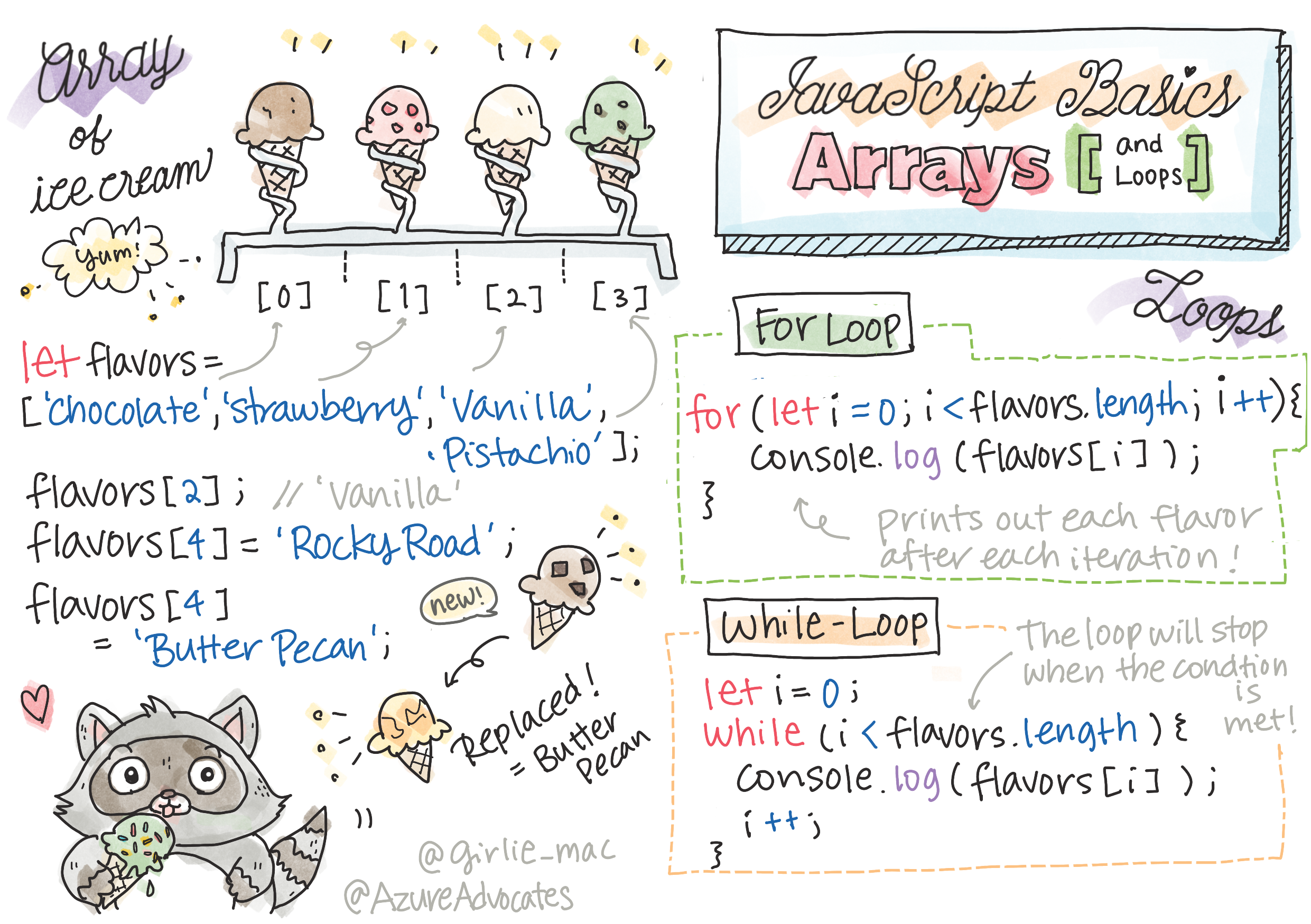
Sketchnote by Tomomi Imura
Pre-Lecture Quiz
Arrays and loops are fundamental building blocks of programming that work together to help you organize and process data efficiently. Think of arrays as digital filing cabinets that can store multiple pieces of related information, while loops act as your tireless assistants that can perform repetitive tasks automatically. These concepts are essential for creating dynamic, interactive web applications.
In this lesson, you'll discover how to create and manipulate arrays to store collections of data, and how to use different types of loops to process that data systematically. You'll also learn how arrays and loops work together to solve real-world programming challenges, from displaying lists of items to processing user input.
By the end of this lesson, you'll be confidently working with arrays and loops to handle data manipulation tasks that would be impossible or impractical to do manually. Let's explore these powerful tools that will transform how you approach programming problems!


🎥 Click the images above for videos about arrays and loops.
You can take this lesson on Microsoft Learn!
Arrays
Arrays are one of the most versatile and commonly used data structures in JavaScript. They allow you to store multiple values in a single variable, making it easy to organize related information and work with collections of data. Whether you're managing a shopping list, storing user names, or handling form responses, arrays provide an elegant solution.
Let's start by understanding how to create and work with arrays in JavaScript.
✅ Arrays are all around us! Can you think of a real-life example of an array, such as a solar panel array?
Creating Arrays
The syntax for an array uses square brackets to contain the elements:
// Empty array - ready to be filled with data
const myArray = [];
Here's what this code does:
- Creates an empty array using square bracket notation
[] - Uses
constfor immutable array reference (recommended modern practice) - Prepares a container ready to store multiple values
Arrays can also be created with initial data, where multiple values are separated by commas:
// Array with initial data
const iceCreamFlavors = ["Chocolate", "Strawberry", "Vanilla", "Pistachio", "Rocky Road"];

// Mixed data types in one array
const userData = ["John", 25, true, "developer"];

// Numbers array
const scores = [95, 87, 92, 78, 85];
Understanding these examples:
- Groups related string values together in the
iceCreamFlavorsarray - Combines different data types (string, number, boolean) in the
userDataarray - Organizes numerical data in the
scoresarray for easy processing
Array Indexing
Each element in an array is assigned a unique position number called an index. Understanding indexing is crucial for accessing and manipulating array data effectively.
| Index | Value | Description |
|---|---|---|
| 0 | "Chocolate" | First element |
| 1 | "Strawberry" | Second element |
| 2 | "Vanilla" | Third element |
| 3 | "Pistachio" | Fourth element |
| 4 | "Rocky Road" | Fifth element |
✅ Does it surprise you that arrays start at the zero index? In some programming languages, indexes start at 1. There's an interesting history around this, which you can read on Wikipedia.
Accessing Array Elements:
const iceCreamFlavors = ["Chocolate", "Strawberry", "Vanilla", "Pistachio", "Rocky Road"];

// Access individual elements using bracket notation
console.log(iceCreamFlavors[0]); // "Chocolate" - first element
console.log(iceCreamFlavors[2]); // "Vanilla" - third element
console.log(iceCreamFlavors[4]); // "Rocky Road" - last element
Breaking down what happens here:
- Uses square bracket notation with the index number to access elements
- Returns the value stored at that specific position in the array
- Starts counting from 0, making the first element index 0
Modifying Array Elements:
// Change an existing value
iceCreamFlavors[4] = "Butter Pecan";
console.log(iceCreamFlavors[4]); // "Butter Pecan"

// Add a new element at the end
iceCreamFlavors[5] = "Cookie Dough";
console.log(iceCreamFlavors[5]); // "Cookie Dough"
In the above, we've:
- Modified the element at index 4 from "Rocky Road" to "Butter Pecan"
- Added a new element "Cookie Dough" at index 5
- Expanded the array length automatically when adding beyond current bounds
Array Length and Common Methods
Arrays come with built-in properties and methods that make working with data much easier.
Finding Array Length:
const iceCreamFlavors = ["Chocolate", "Strawberry", "Vanilla", "Pistachio", "Rocky Road"];
console.log(iceCreamFlavors.length); // 5

// Length updates automatically as array changes
iceCreamFlavors.push("Mint Chip");
console.log(iceCreamFlavors.length); // 6
Key points to remember:
- Returns the total number of elements in the array
- Updates automatically when elements are added or removed
- Provides a dynamic count useful for loops and validation
Essential Array Methods:
const fruits = ["apple", "banana", "orange"];

// Add elements
fruits.push("grape");           // Adds to end: ["apple", "banana", "orange", "grape"]
fruits.unshift("strawberry");   // Adds to beginning: ["strawberry", "apple", "banana", "orange", "grape"]

// Remove elements
const lastFruit = fruits.pop();        // Removes and returns "grape"
const firstFruit = fruits.shift();     // Removes and returns "strawberry"

// Find elements
const index = fruits.indexOf("banana"); // Returns 1 (position of "banana")
const hasApple = fruits.includes("apple"); // Returns true
Understanding these methods:
- Adds elements with
push()(end) andunshift()(beginning) - Removes elements with
pop()(end) andshift()(beginning) - Locates elements with
indexOf()and checks existence withincludes() - Returns useful values like removed elements or position indexes
✅ Try it yourself! Use your browser's console to create and manipulate an array of your own creation.
Loops
Loops are powerful programming constructs that allow you to execute code repeatedly without writing the same statements multiple times. They're essential for processing arrays, generating sequences, and automating repetitive tasks. Think of loops as your programming automation tools – they handle the tedious work so you can focus on solving bigger problems.
JavaScript provides several types of loops, each with specific strengths and use cases. Let's explore the most common ones and learn when to use each type.
For Loop
The for loop is perfect when you know exactly how many times you want to repeat something. It's structured and predictable, making it ideal for array processing and counting operations.
For Loop Structure:
| Component | Purpose | Example |
|---|---|---|
| Initialization | Sets starting point | let i = 0 |
| Condition | When to continue | i < 10 |
| Increment | How to update | i++ |
// Counting from 0 to 9
for (let i = 0; i < 10; i++) {
  console.log(`Count: ${i}`);
}

// More practical example: processing scores
const testScores = [85, 92, 78, 96, 88];
for (let i = 0; i < testScores.length; i++) {
  console.log(`Student ${i + 1}: ${testScores[i]}%`);
}
Step by step, here's what's happening:
- Initializes the counter variable
ito 0 at the start - Checks the condition
i < 10before each iteration - Executes the code block when the condition is true
- Increments
iby 1 after each iteration withi++ - Stops when the condition becomes false (when
ireaches 10)
✅ Run this code in a browser console. What happens when you make small changes to the counter, condition, or iteration expression? Can you make it run backwards, creating a countdown?
While Loop
The while loop is ideal when you don't know exactly how many iterations you'll need, but you have a clear condition for when to stop. It's particularly useful for user input validation, searching through data, or processing until a specific state is reached.
While Loop Characteristics:
- Continues executing as long as the condition is true
- Requires manual management of any counter variables
- Checks the condition before each iteration
- Risks infinite loops if the condition never becomes false
// Basic counting example
let i = 0;
while (i < 10) {
  console.log(`While count: ${i}`);
  i++; // Don't forget to increment!
}

// More practical example: processing user input
let userInput = "";
let attempts = 0;
const maxAttempts = 3;

while (userInput !== "quit" && attempts < maxAttempts) {
  userInput = prompt(`Enter 'quit' to exit (attempt ${attempts + 1}):`);
  attempts++;
}

if (attempts >= maxAttempts) {
  console.log("Maximum attempts reached!");
}
Understanding these examples:
- Manages the counter variable
imanually inside the loop body - Increments the counter to prevent infinite loops
- Demonstrates practical use case with user input and attempt limiting
- Includes safety mechanisms to prevent endless execution
Modern Loop Alternatives
JavaScript offers modern loop syntax that can make your code more readable and less error-prone.
For...of Loop (ES6+):
const colors = ["red", "green", "blue", "yellow"];

// Modern approach - cleaner and safer
for (const color of colors) {
  console.log(`Color: ${color}`);
}

// Compare with traditional for loop
for (let i = 0; i < colors.length; i++) {
  console.log(`Color: ${colors[i]}`);
}
Key advantages of for...of:
- Eliminates index management and potential off-by-one errors
- Provides direct access to array elements
- Improves code readability and reduces syntax complexity
forEach Method:
const prices = [9.99, 15.50, 22.75, 8.25];

// Using forEach for functional programming style
prices.forEach((price, index) => {
  console.log(`Item ${index + 1}: $${price.toFixed(2)}`);
});

// forEach with arrow functions for simple operations
prices.forEach(price => console.log(`Price: $${price}`));
What you need to know about forEach:
- Executes a function for each array element
- Provides both element value and index as parameters
- Cannot be stopped early (unlike traditional loops)
- Returns undefined (doesn't create a new array)
✅ Why would you choose a for loop vs. a while loop? 17K viewers had the same question on StackOverflow, and some of the opinions might be interesting to you.
Loops and Arrays
Combining arrays with loops creates powerful data processing capabilities. This pairing is fundamental to many programming tasks, from displaying lists to calculating statistics.
Traditional Array Processing:
const iceCreamFlavors = ["Chocolate", "Strawberry", "Vanilla", "Pistachio", "Rocky Road"];

// Classic for loop approach
for (let i = 0; i < iceCreamFlavors.length; i++) {
  console.log(`Flavor ${i + 1}: ${iceCreamFlavors[i]}`);
}

// Modern for...of approach
for (const flavor of iceCreamFlavors) {
  console.log(`Available flavor: ${flavor}`);
}
Let's understand each approach:
- Uses array length property to determine loop boundary
- Accesses elements by index in traditional for loops
- Provides direct element access in for...of loops
- Processes each array element exactly once
Practical Data Processing Example:
const studentGrades = [85, 92, 78, 96, 88, 73, 89];
let total = 0;
let highestGrade = studentGrades[0];
let lowestGrade = studentGrades[0];

// Process all grades with a single loop
for (let i = 0; i < studentGrades.length; i++) {
  const grade = studentGrades[i];
  total += grade;

  if (grade > highestGrade) {
    highestGrade = grade;
  }

  if (grade < lowestGrade) {
    lowestGrade = grade;
  }
}

const average = total / studentGrades.length;
console.log(`Average: ${average.toFixed(1)}`);
console.log(`Highest: ${highestGrade}`);
console.log(`Lowest: ${lowestGrade}`);
Here's how this code works:
- Initializes tracking variables for sum and extremes
- Processes each grade with a single efficient loop
- Accumulates the total for average calculation
- Tracks highest and lowest values during iteration
- Calculates final statistics after loop completion
✅ Experiment with looping over an array of your own making in your browser's console.
GitHub Copilot Agent Challenge 🚀
Use the Agent mode to complete the following challenge:
Description: Build a comprehensive data processing function that combines arrays and loops to analyze a dataset and generate meaningful insights.
Prompt: Create a function called analyzeGrades that takes an array of student grade objects (each containing name and score properties) and returns an object with statistics including the highest score, lowest score, average score, count of students who passed (score >= 70), and an array of student names who scored above average. Use at least two different loop types in your solution.
🚀 Challenge
JavaScript offers several modern array methods that can replace traditional loops for specific tasks. Explore forEach, for-of, map, filter, and reduce.
Your challenge: Rewrite the student grades analysis using at least three different modern array methods. Compare the readability and efficiency of your solutions.
Post-Lecture Quiz
Review & Self Study
Arrays in JavaScript have many methods attached to them, that are extremely useful for data manipulation. Read up on these methods and try some of them out (like push, pop, slice and splice) on an array of your creation.