
 chris
fe82727158
chris
fe82727158
|
1 month ago | |
|---|---|---|
| .. | ||
| images | ||
| README.md | ||
| assignment.md | ||
README.md
Terrarium Project Part 1: Introduction to HTML
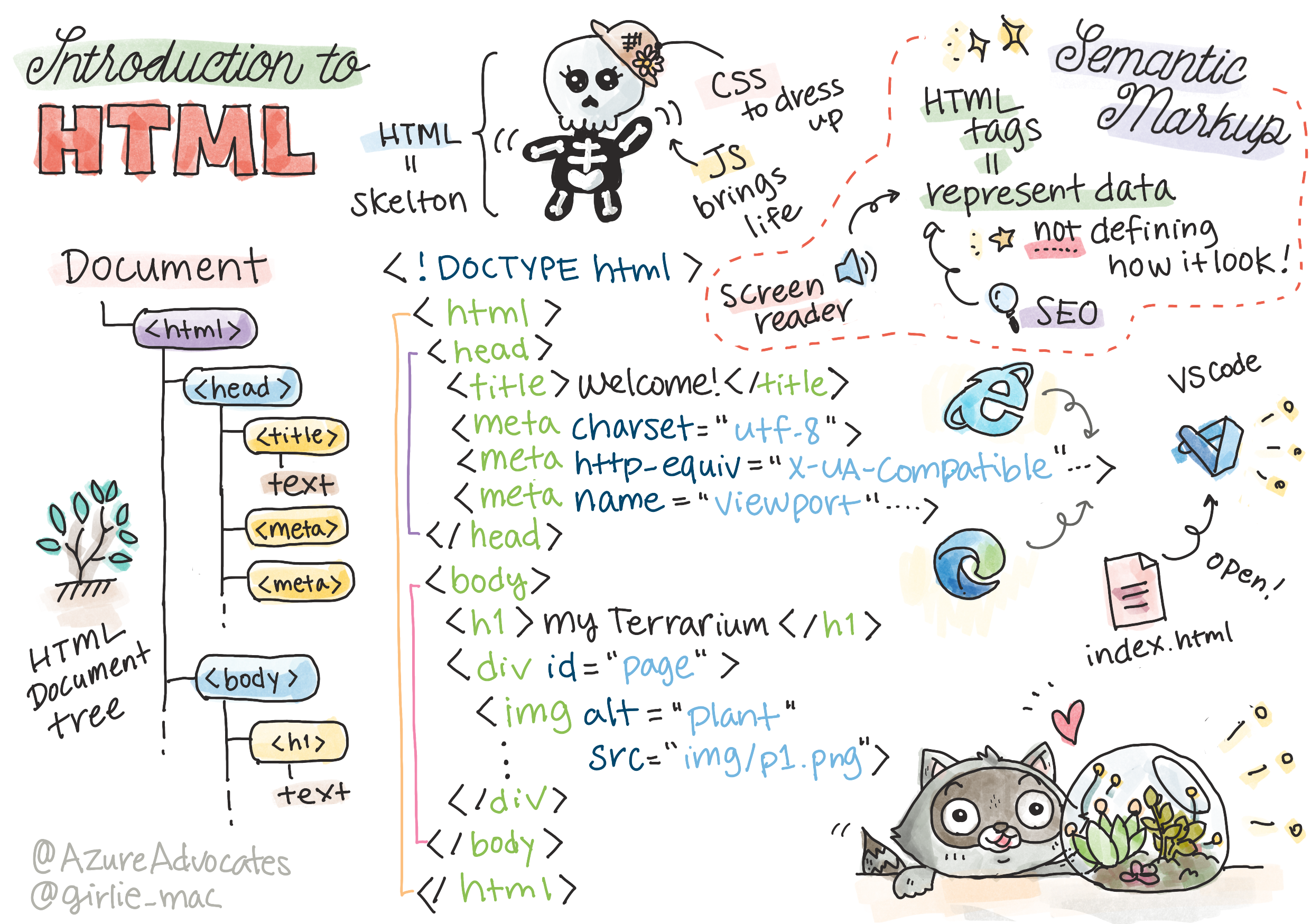
Sketchnote by Tomomi Imura
HTML, or HyperText Markup Language, is the foundation of every website you've ever visited. Think of HTML as the skeleton that gives structure to web pages – it defines where content goes, how it's organized, and what each piece represents. While CSS will later "dress up" your HTML with colors and layouts, and JavaScript will bring it to life with interactivity, HTML provides the essential structure that makes everything else possible.
In this lesson, you'll create the HTML structure for a virtual terrarium interface. This hands-on project will teach you fundamental HTML concepts while building something visually engaging. You'll learn how to organize content using semantic elements, work with images, and create the foundation for an interactive web application.
By the end of this lesson, you'll have a working HTML page displaying plant images in organized columns, ready for styling in the next lesson. Don't worry if it looks basic at first – that's exactly what HTML should do before CSS adds the visual polish.
Pre-Lecture Quiz
📺 Watch and Learn: Check out this helpful video overview

Setting Up Your Project
Before we dive into HTML code, let's set up a proper workspace for your terrarium project. Creating an organized file structure from the beginning is a crucial habit that will serve you well throughout your web development journey.
Task: Create Your Project Structure
You'll create a dedicated folder for your terrarium project and add your first HTML file. Here are two approaches you can use:
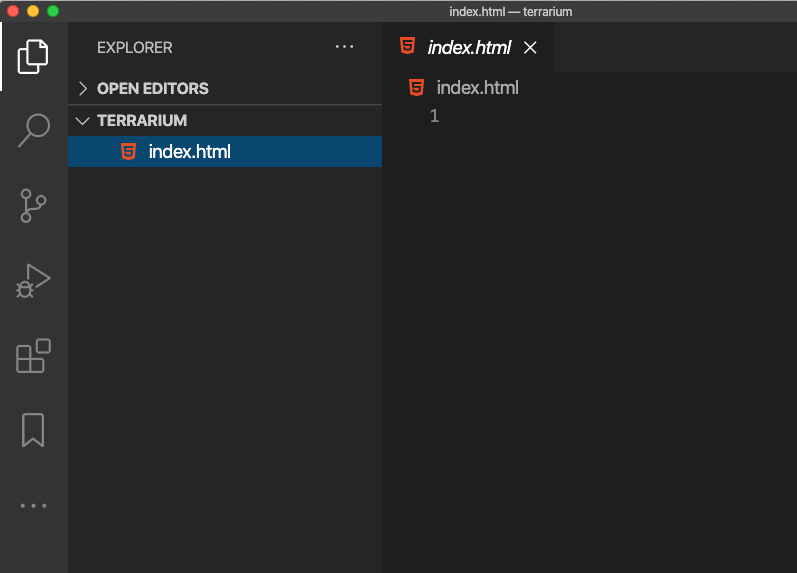
Option 1: Using Visual Studio Code
- Open Visual Studio Code
- Click "File" → "Open Folder" or use
Ctrl+K, Ctrl+O(Windows/Linux) orCmd+K, Cmd+O(Mac) - Create a new folder called
terrariumand select it - In the Explorer pane, click the "New File" icon
- Name your file
index.html
Option 2: Using Terminal Commands
mkdir terrarium
cd terrarium
touch index.html
code index.html
Here's what these commands accomplish:
- Creates a new directory called
terrariumfor your project - Navigates into the terrarium directory
- Creates an empty
index.htmlfile - Opens the file in Visual Studio Code for editing
💡 Pro Tip: The filename
index.htmlis special in web development. When someone visits a website, browsers automatically look forindex.htmlas the default page to display. This means a URL likehttps://mysite.com/projects/will automatically serve theindex.htmlfile from theprojectsfolder without needing to specify the filename in the URL.
Understanding HTML Document Structure
Every HTML document follows a specific structure that browsers need to understand and display correctly. Think of this structure like a formal letter – it has required elements in a particular order that help the recipient (in this case, the browser) process the content properly.
Let's start by adding the essential foundation that every HTML document needs.
The DOCTYPE Declaration and Root Element
The first two lines of any HTML file serve as the document's "introduction" to the browser:
<!DOCTYPE html>
<html></html>
Understanding what this code does:
- Declares the document type as HTML5 using
<!DOCTYPE html> - Creates the root
<html>element that will contain all page content - Establishes modern web standards for proper browser rendering
- Ensures consistent display across different browsers and devices
💡 VS Code Tip: Hover over any HTML tag in VS Code to see helpful information from MDN Web Docs, including usage examples and browser compatibility details.
📚 Learn More: The DOCTYPE declaration prevents browsers from entering "quirks mode," which was used to support very old websites. Modern web development uses the simple
<!DOCTYPE html>declaration to ensure standards-compliant rendering.
Adding Essential Document Metadata
The <head> section of an HTML document contains crucial information that browsers and search engines need, but that visitors don't see directly on the page. Think of it as the "behind-the-scenes" information that helps your webpage work properly and appear correctly across different devices and platforms.
This metadata tells browsers how to display your page, what character encoding to use, and how to handle different screen sizes – all essential for creating professional, accessible web pages.
Task: Add the Document Head
Insert this <head> section between your opening and closing <html> tags:
<head>
	<title>Welcome to my Virtual Terrarium</title>
	<meta charset="utf-8" />
	<meta http-equiv="X-UA-Compatible" content="IE=edge" />
	<meta name="viewport" content="width=device-width, initial-scale=1" />
</head>
Breaking down what each element accomplishes:
- Sets the page title that appears in browser tabs and search results
- Specifies UTF-8 character encoding for proper text display worldwide
- Ensures compatibility with modern versions of Internet Explorer
- Configures responsive design by setting the viewport to match device width
- Controls initial zoom level to display content at natural size
🤔 Think About This: What would happen if you set a viewport meta tag like this:
<meta name="viewport" content="width=600">? This would force the page to always be 600 pixels wide, breaking responsive design! Learn more about proper viewport configuration.
Building the Document Body
The <body> element contains all the visible content of your webpage – everything users will see and interact with. While the <head> section provided instructions to the browser, the <body> section contains the actual content: text, images, buttons, and other elements that create your user interface.
Let's add the body structure and understand how HTML tags work together to create meaningful content.
Understanding HTML Tag Structure
HTML uses paired tags to define elements. Most tags have an opening tag like <p> and a closing tag like </p>, with content in between: <p>Hello, world!</p>. This creates a paragraph element containing the text "Hello, world!".
Task: Add the Body Element
Update your HTML file to include the <body> element:
<!DOCTYPE html>
<html>
	<head>
		<title>Welcome to my Virtual Terrarium</title>
		<meta charset="utf-8" />
		<meta http-equiv="X-UA-Compatible" content="IE=edge" />
		<meta name="viewport" content="width=device-width, initial-scale=1" />
	</head>
	<body></body>
</html>
Here's what this complete structure provides:
- Establishes the basic HTML5 document framework
- Includes essential metadata for proper browser rendering
- Creates an empty body ready for your visible content
- Follows modern web development best practices
Now you're ready to add the visible elements of your terrarium. We'll use <div> elements as containers to organize different sections of content, and <img> elements to display the plant images.
Working with Images and Layout Containers
Images are special in HTML because they use "self-closing" tags. Unlike elements like <p></p> that wrap around content, the <img> tag contains all the information it needs within the tag itself using attributes like src for the image file path and alt for accessibility.
Before adding images to your HTML, you'll need to organize your project files properly by creating an images folder and adding the plant graphics.
First, set up your images:
- Create a folder called
imagesinside your terrarium project folder - Download the plant images from the solution folder (14 plant images total)
- Copy all plant images into your new
imagesfolder
Task: Create the Plant Display Layout
Now add the plant images organized in two columns between your <body></body> tags:
<div id="page">
	<div id="left-container" class="container">
		<div class="plant-holder">
			<img class="plant" alt="plant" id="plant1" src="./images/plant1.png" />
		</div>
		<div class="plant-holder">
			<img class="plant" alt="plant" id="plant2" src="./images/plant2.png" />
		</div>
		<div class="plant-holder">
			<img class="plant" alt="plant" id="plant3" src="./images/plant3.png" />
		</div>
		<div class="plant-holder">
			<img class="plant" alt="plant" id="plant4" src="./images/plant4.png" />
		</div>
		<div class="plant-holder">
			<img class="plant" alt="plant" id="plant5" src="./images/plant5.png" />
		</div>
		<div class="plant-holder">
			<img class="plant" alt="plant" id="plant6" src="./images/plant6.png" />
		</div>
		<div class="plant-holder">
			<img class="plant" alt="plant" id="plant7" src="./images/plant7.png" />
		</div>
	</div>
	<div id="right-container" class="container">
		<div class="plant-holder">
			<img class="plant" alt="plant" id="plant8" src="./images/plant8.png" />
		</div>
		<div class="plant-holder">
			<img class="plant" alt="plant" id="plant9" src="./images/plant9.png" />
		</div>
		<div class="plant-holder">
			<img class="plant" alt="plant" id="plant10" src="./images/plant10.png" />
		</div>
		<div class="plant-holder">
			<img class="plant" alt="plant" id="plant11" src="./images/plant11.png" />
		</div>
		<div class="plant-holder">
			<img class="plant" alt="plant" id="plant12" src="./images/plant12.png" />
		</div>
		<div class="plant-holder">
			<img class="plant" alt="plant" id="plant13" src="./images/plant13.png" />
		</div>
		<div class="plant-holder">
			<img class="plant" alt="plant" id="plant14" src="./images/plant14.png" />
		</div>
	</div>
</div>
Step by step, here's what's happening in this code:
- Creates a main page container with
id="page"to hold all content - Establishes two column containers:
left-containerandright-container - Organizes 7 plants in the left column and 7 plants in the right column
- Wraps each plant image in a
plant-holderdiv for individual positioning - Applies consistent class names for CSS styling in the next lesson
- Assigns unique IDs to each plant image for JavaScript interaction later
- Includes proper file paths pointing to the images folder
🤔 Consider This: Notice that all images currently have the same alt text "plant". This isn't ideal for accessibility. Screen reader users would hear "plant" repeated 14 times without knowing which specific plant each image shows. Can you think of better, more descriptive alt text for each image?
📝 HTML Element Types:
<div>elements are "block-level" and take up full width, while<span>elements are "inline" and only take up necessary width. What do you think would happen if you changed all these<div>tags to<span>tags?
With this markup added, the plants will appear on screen, though they won't look polished yet – that's what CSS is for in the next lesson! For now, you have a solid HTML foundation that properly organizes your content and follows accessibility best practices.
Using Semantic HTML for Accessibility
Semantic HTML means choosing HTML elements based on their meaning and purpose, not just their appearance. When you use semantic markup, you're communicating the structure and meaning of your content to browsers, search engines, and assistive technologies like screen readers.
This approach makes your websites more accessible to users with disabilities and helps search engines better understand your content. It's a fundamental principle of modern web development that creates better experiences for everyone.
Adding a Semantic Page Title
Let's add a proper heading to your terrarium page. Insert this line right after your opening <body> tag:
<h1>My Terrarium</h1>
Why semantic markup matters:
- Helps screen readers navigate and understand page structure
- Improves search engine optimization (SEO) by clarifying content hierarchy
- Enhances accessibility for users with visual impairments or cognitive differences
- Creates better user experiences across all devices and platforms
- Follows web standards and best practices for professional development
Examples of semantic vs. non-semantic choices:
| Purpose | ✅ Semantic Choice | ❌ Non-Semantic Choice |
|---|---|---|
| Main heading | <h1>Title</h1> |
<div class="big-text">Title</div> |
| Navigation | <nav><ul><li></li></ul></nav> |
<div class="menu"><div></div></div> |
| Button | <button>Click me</button> |
<span onclick="...">Click me</span> |
| Article content | <article><p></p></article> |
<div class="content"><div></div></div> |
🎥 See It in Action: Watch how screen readers interact with web pages to understand why semantic markup is crucial for accessibility. Notice how proper HTML structure helps users navigate efficiently.
Creating the Terrarium Container
Now let's add the HTML structure for the terrarium itself – the glass container where plants will eventually be placed. This section demonstrates an important concept: HTML provides structure, but without CSS styling, these elements won't be visible yet.
The terrarium markup uses descriptive class names that will make CSS styling intuitive and maintainable in the next lesson.
Task: Add the Terrarium Structure
Insert this markup above the last </div> tag (before the closing tag of the page container):
<div id="terrarium">
	<div class="jar-top"></div>
	<div class="jar-walls">
		<div class="jar-glossy-long"></div>
		<div class="jar-glossy-short"></div>
	</div>
	<div class="dirt"></div>
	<div class="jar-bottom"></div>
</div>
Understanding this terrarium structure:
- Creates a main terrarium container with a unique ID for styling
- Defines separate elements for each visual component (top, walls, dirt, bottom)
- Includes nested elements for glass reflection effects (glossy elements)
- Uses descriptive class names that clearly indicate each element's purpose
- Prepares the structure for CSS styling that will create the glass terrarium appearance
🤔 Notice Something?: Even though you added this markup, you don't see anything new on the page! This perfectly illustrates how HTML provides structure while CSS provides appearance. These
<div>elements exist but have no visual styling yet – that's coming in the next lesson!
GitHub Copilot Agent Challenge
Use the Agent mode to complete the following challenge:
Description: Create a semantic HTML structure for a plant care guide section that could be added to the terrarium project.
Prompt: Create a semantic HTML section that includes a main heading "Plant Care Guide", three subsections with headings "Watering", "Light Requirements", and "Soil Care", each containing a paragraph of plant care information. Use proper semantic HTML tags like <section>, <h2>, <h3>, and <p> to structure the content appropriately.
Learn more about agent mode here.
Explore HTML History Challenge
Learning About Web Evolution
HTML has evolved significantly since Tim Berners-Lee created the first web browser at CERN in 1990. Some older tags like <marquee> are now deprecated because they don't work well with modern accessibility standards and responsive design principles.
Try This Experiment:
- Temporarily wrap your
<h1>title in a<marquee>tag:<marquee><h1>My Terrarium</h1></marquee> - Open your page in a browser and observe the scrolling effect
- Consider why this tag was deprecated (hint: think about user experience and accessibility)
- Remove the
<marquee>tag and return to semantic markup
Reflection Questions:
- How might a scrolling title affect users with visual impairments or motion sensitivity?
- What modern CSS techniques could achieve similar visual effects more accessibly?
- Why is it important to use current web standards instead of deprecated elements?
Explore more about obsolete and deprecated HTML elements to understand how web standards evolve to improve user experience.
Post-Lecture Quiz
Review & Self Study
Deepen Your HTML Knowledge
HTML has been the foundation of the web for over 30 years, evolving from a simple document markup language to a sophisticated platform for building interactive applications. Understanding this evolution helps you appreciate modern web standards and make better development decisions.
Recommended Learning Paths:
-
HTML History and Evolution
- Research the timeline from HTML 1.0 to HTML5
- Explore why certain tags were deprecated (accessibility, mobile-friendliness, maintainability)
- Investigate emerging HTML features and proposals
-
Semantic HTML Deep Dive
- Study the complete list of HTML5 semantic elements
- Practice identifying when to use
<article>,<section>,<aside>, and<main> - Learn about ARIA attributes for enhanced accessibility
-
Modern Web Development
- Explore building responsive websites on Microsoft Learn
- Understand how HTML integrates with CSS and JavaScript
- Learn about web performance and SEO best practices
Reflection Questions:
- Which deprecated HTML tags did you discover, and why were they removed?
- What new HTML features are being proposed for future versions?
- How does semantic HTML contribute to web accessibility and SEO?