
12 KiB
JavaScript Basics: Methods and Functions
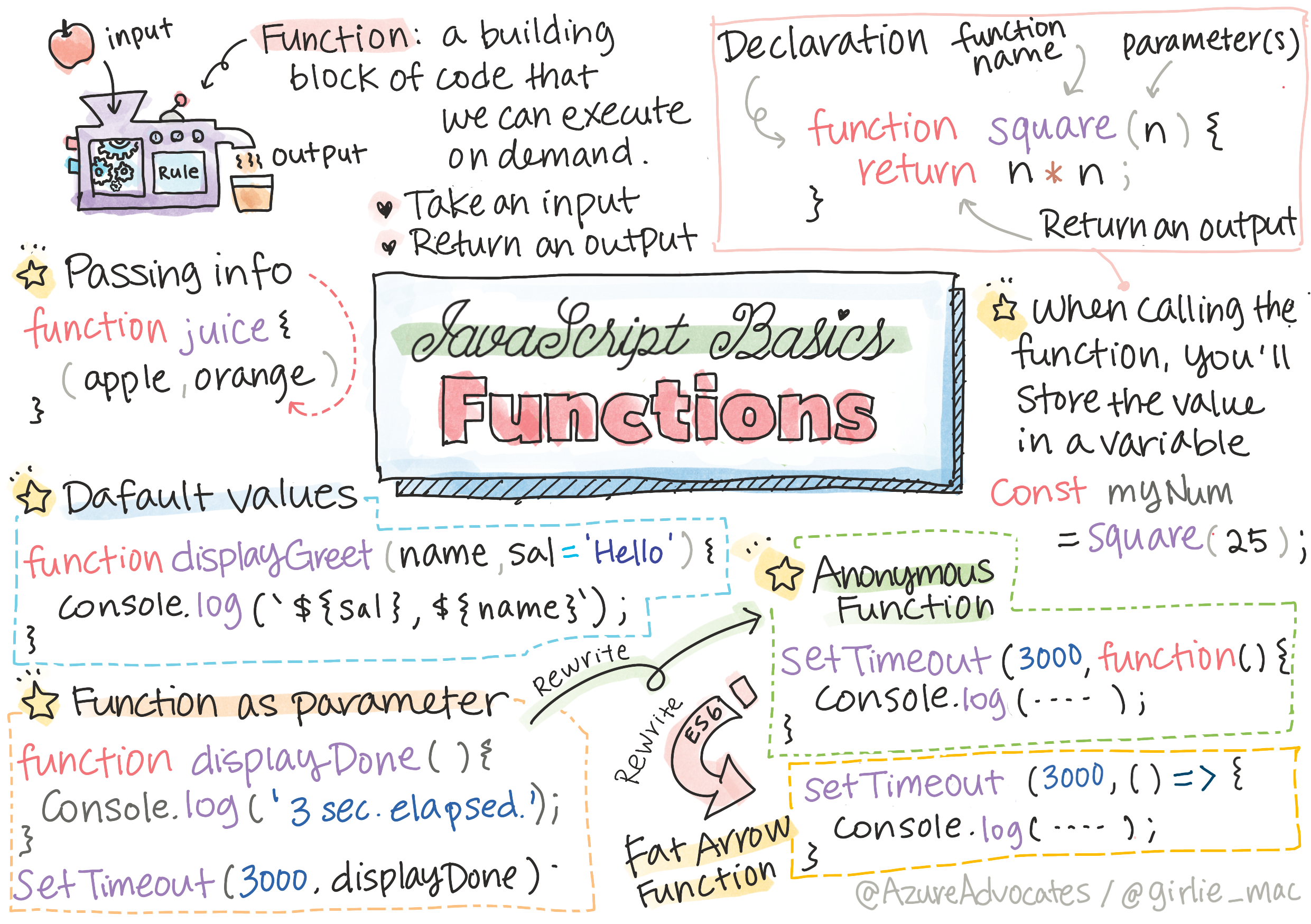
Sketchnote by Tomomi Imura
Pre-Lecture Quiz
Writing the same code repeatedly is one of programming's most common frustrations. Functions solve this problem by letting you package code into reusable blocks. Think of functions like the standardized parts that made Henry Ford's assembly line revolutionary – once you create a reliable component, you can use it wherever needed without rebuilding from scratch.
Functions allow you to bundle pieces of code so you can reuse them throughout your program. Instead of copying and pasting the same logic everywhere, you can create a function once and call it whenever needed. This approach keeps your code organized and makes updates much easier.
In this lesson, you'll learn how to create your own functions, pass information to them, and get useful results back. You'll discover the difference between functions and methods, learn modern syntax approaches, and see how functions can work with other functions. We'll build these concepts step by step.
🎥 Click the image above for a video about methods and functions.
You can take this lesson on Microsoft Learn!
Functions
A function is a self-contained block of code that performs a specific task. It encapsulates logic that you can execute whenever needed.
Instead of writing the same code multiple times throughout your program, you can package it in a function and call that function whenever you need it. This approach keeps your code clean and makes updates much easier. Consider the maintenance challenge if you needed to change logic that was scattered across 20 different locations in your codebase.
Naming your functions descriptively is essential. A well-named function communicates its purpose clearly – when you see cancelTimer(), you immediately understand what it does, just as a clearly labeled button tells you exactly what will happen when you click it.
Creating and calling a function
Let's examine how to create a function. The syntax follows a consistent pattern:
function nameOfFunction() { // function definition
 // function definition/body
}
Let's break this down:
- The
functionkeyword tells JavaScript "Hey, I'm creating a function!" nameOfFunctionis where you give your function a descriptive name- The parentheses
()are where you can add parameters (we'll get to that soon) - The curly braces
{}contain the actual code that runs when you call the function
Let's create a simple greeting function to see this in action:
function displayGreeting() {
  console.log('Hello, world!');
}
This function prints "Hello, world!" to the console. Once you've defined it, you can use it as many times as needed.
To execute (or "call") your function, write its name followed by parentheses. JavaScript allows you to define your function before or after you call it – the JavaScript engine will handle the execution order.
// calling our function
displayGreeting();
When you run this line, it executes all the code inside your displayGreeting function, displaying "Hello, world!" in your browser's console. You can call this function repeatedly.
Note: You've been using methods throughout these lessons.
console.log()is a method – essentially a function that belongs to theconsoleobject. The key difference is that methods are attached to objects, while functions stand independently. Many developers use these terms interchangeably in casual conversation.
Function best practices
Here are a few tips to help you write great functions:
- Give your functions clear, descriptive names – your future self will thank you!
- Use camelCasing for multi-word names (like
calculateTotalinstead ofcalculate_total) - Keep each function focused on doing one thing well
Passing information to a function
Our displayGreeting function is limited – it can only display "Hello, world!" for everyone. Parameters allow us to make functions more flexible and useful.
Parameters act like placeholders where you can insert different values each time you use the function. This way, the same function can work with different information on each call.
You list parameters inside the parentheses when you define your function, separating multiple parameters with commas:
function name(param, param2, param3) {

}
Each parameter acts like a placeholder – when someone calls your function, they'll provide actual values that get plugged into these spots.
Let's update our greeting function to accept someone's name:
function displayGreeting(name) {
  const message = `Hello, ${name}!`;
  console.log(message);
}
Notice how we're using backticks (`) and ${} to insert the name directly into our message – this is called a template literal, and it's a really handy way to build strings with variables mixed in.
Now when we call our function, we can pass in any name:
displayGreeting('Christopher');
// displays "Hello, Christopher!" when run
JavaScript takes the string 'Christopher', assigns it to the name parameter, and creates the personalized message "Hello, Christopher!"
Default values
What if we want to make some parameters optional? That's where default values come in handy!
Let's say we want people to be able to customize the greeting word, but if they don't specify one, we'll just use "Hello" as a fallback. You can set up default values by using the equals sign, just like setting a variable:
function displayGreeting(name, salutation='Hello') {
  console.log(`${salutation}, ${name}`);
}
Here, name is still required, but salutation has a backup value of 'Hello' if no one provides a different greeting.
Now we can call this function in two different ways:
displayGreeting('Christopher');
// displays "Hello, Christopher"

displayGreeting('Christopher', 'Hi');
// displays "Hi, Christopher"
In the first call, JavaScript uses the default "Hello" since we didn't specify a salutation. In the second call, it uses our custom "Hi" instead. This flexibility makes functions adaptable to different scenarios.
Return values
Our functions so far have just been printing messages to the console, but what if you want a function to calculate something and give you back the result?
That's where return values come in. Instead of just displaying something, a function can hand you back a value that you can store in a variable or use in other parts of your code.
To send a value back, you use the return keyword followed by whatever you want to return:
return myVariable;
Here's something important: when a function hits a return statement, it immediately stops running and sends that value back to whoever called it.
Let's modify our greeting function to return the message instead of printing it:
function createGreetingMessage(name) {
  const message = `Hello, ${name}`;
  return message;
}
Now instead of printing the greeting, this function creates the message and hands it back to us.
To use the returned value, we can store it in a variable just like any other value:
const greetingMessage = createGreetingMessage('Christopher');
Now greetingMessage contains "Hello, Christopher" and we can use it anywhere in our code – to display it on a webpage, include it in an email, or pass it to another function.
Functions as parameters for functions
Functions can be passed as parameters to other functions. While this concept may seem complex initially, it's a powerful feature that enables flexible programming patterns.
This pattern is super common when you want to say "when something happens, do this other thing." For example, "when the timer finishes, run this code" or "when the user clicks the button, call this function."
Let's look at setTimeout, which is a built-in function that waits a certain amount of time and then runs some code. We need to tell it what code to run – perfect use case for passing a function!
Try this code – after 3 seconds, you'll see a message:
function displayDone() {
  console.log('3 seconds has elapsed');
}
// timer value is in milliseconds
setTimeout(displayDone, 3000);
Notice how we pass displayDone (without parentheses) to setTimeout. We're not calling the function ourselves – we're handing it over to setTimeout and saying "call this in 3 seconds."
Anonymous functions
Sometimes you need a function for just one thing and don't want to give it a name. Think about it – if you're only using a function once, why clutter up your code with an extra name?
JavaScript lets you create anonymous functions – functions without names that you can define right where you need them.
Here's how we can rewrite our timer example using an anonymous function:
setTimeout(function() {
  console.log('3 seconds has elapsed');
}, 3000);
This achieves the same result, but the function is defined directly within the setTimeout call, eliminating the need for a separate function declaration.
Fat arrow functions
Modern JavaScript has an even shorter way to write functions called arrow functions. They use => (which looks like an arrow – get it?) and are super popular with developers.
Arrow functions let you skip the function keyword and write more concise code.
Here's our timer example using an arrow function:
setTimeout(() => {
  console.log('3 seconds has elapsed');
}, 3000);
The () is where parameters would go (empty in this case), then comes the arrow =>, and finally the function body in curly braces. This provides the same functionality with more concise syntax.
When to use each strategy
When should you use each approach? A practical guideline: if you'll use the function multiple times, give it a name and define it separately. If it's for one specific use, consider an anonymous function. Both arrow functions and traditional syntax are valid choices, though arrow functions are prevalent in modern JavaScript codebases.
🚀 Challenge
Can you articulate in one sentence the difference between functions and methods? Give it a try!
GitHub Copilot Agent Challenge 🚀
Use the Agent mode to complete the following challenge:
Description: Create a utility library of mathematical functions that demonstrates different function concepts covered in this lesson, including parameters, default values, return values, and arrow functions.
Prompt: Create a JavaScript file called mathUtils.js that contains the following functions:
- A function
addthat takes two parameters and returns their sum - A function
multiplywith default parameter values (second parameter defaults to 1) - An arrow function
squarethat takes a number and returns its square - A function
calculatethat accepts another function as a parameter and two numbers, then applies the function to those numbers - Demonstrate calling each function with appropriate test cases
Learn more about agent mode here.
Post-Lecture Quiz
Review & Self Study
It's worth reading up a little more on arrow functions, as they are increasingly used in code bases. Practice writing a function, and then rewriting it with this syntax.