
 localizeflow[bot]
9e661e295d
localizeflow[bot]
9e661e295d
|
8 months ago | |
|---|---|---|
| .. | ||
| README.md | 8 months ago | |
| assignment.md | 8 months ago | |
README.md
JavaScript Basics: Making Decisions
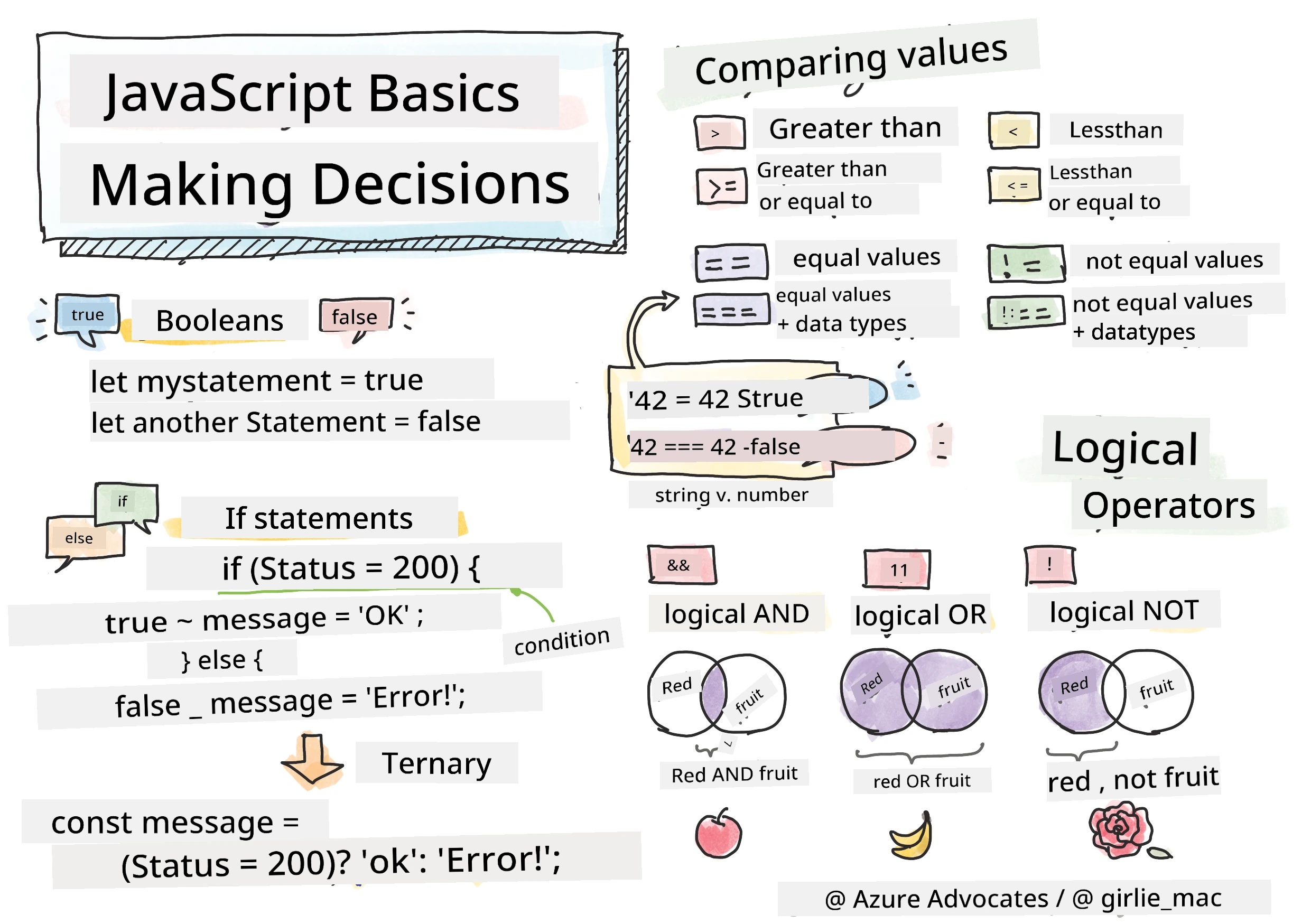
Sketchnote by Tomomi Imura
journey
    title Your JavaScript Decision-Making Adventure
    section Foundation
      Boolean Values: 5: You
      Comparison Operators: 4: You
      Logical Thinking: 5: You
    section Basic Decisions
      If Statements: 4: You
      If-Else Logic: 5: You
      Switch Statements: 4: You
    section Advanced Logic
      Logical Operators: 5: You
      Complex Conditions: 4: You
      Ternary Expressions: 5: You
You don ever wonder how applications dey make correct decisions? Like how navigation system dey pick di fastest road, or how thermostat know when e go turn on heat? Na di koko idea of decision-making for programming be dis.
Just like how Charles Babbage Analytical Engine design to follow different sequence of operations based on some conditions, modern JavaScript programs need to make choice based on varying condition dem. Dis ability to branch out and make decision na wetin dey turn static code to smart, responsive apps.
For dis lesson, you go learn how to implement conditional logic for your programs. We go explore conditional statements, comparison operators, and logical expressions wey go allow your code check situation and respond well.
Pre-Lecture Quiz
Di ability to make decisions and control program flow na one important part of programming. Dis section go show how you fit control how your JavaScript program dey run using Boolean values and conditional logic.
🎥 Click di picture wey dey top for video about making decisions.
You fit take dis lesson for Microsoft Learn!
mindmap
  root((Decision Making))
    Boolean Logic
      true/false
      Comparison results
      Logical expressions
    Conditional Statements
      if statements
        Single condition
        Code execution
      if-else
        Two paths
        Alternative actions
      switch
        Multiple options
        Clean structure
    Operators
      Comparison
        === !== < > <= >=
        Value relationships
      Logical
        && || !
        Combine conditions
    Advanced Patterns
      Ternary
        ? : syntax
        Inline decisions
      Complex Logic
        Nested conditions
        Multiple criteria
A Brief Recap on Booleans
Before we start decision-making, make we remember Boolean values from our last lesson. Named after mathematician George Boole, dis values mean binary states – e fit be true or false. No wahala, no middle ground.
Dis binary values na di foundation for all computational logic. Every decision your program make, at the end be Boolean evaluation.
To create Boolean variables no too hard:
let myTrueBool = true;
let myFalseBool = false;
Dis one create two variables wey get explicit Boolean values.
✅ Booleans get their name from English mathematician, philosopher and logician George Boole (1815–1864).
Comparison Operators and Booleans
For practice, you no go usually dey set Boolean values by hand. You go dey generate them by checking conditions: "Dis number bigger pass dat?" or "Dem two values be equal?"
Comparison operators na wetin dey do dis checking. Dem dey compare values and return Boolean result based on how the two things relate.
| Symbol | Description | Example |
|---|---|---|
< |
Less than: Dey compare two values, returns true if the value wey dey left side smaller than the one wey dey right |
5 < 6 // true |
<= |
Less than or equal to: Returns true if value wey dey left side smaller or equal to the one wey dey right |
5 <= 6 // true |
> |
Greater than: Returns true if value wey dey left side bigger pass the one wey dey right |
5 > 6 // false |
>= |
Greater than or equal to: Returns true if value wey dey left side bigger or equal to the one wey dey right |
5 >= 6 // false |
=== |
Strict equality: Returns true if values for both left and right side equal AND their data types na the same |
5 === 6 // false |
!== |
Inequality: Returns opposite of wetin strict equality go return | 5 !== 6 // true |
✅ Try test your knowledge by writing some comparisons for your browser console. Any result go surprise you?
flowchart LR
    A["🔢 Values"] --> B["⚖️ Comparison"]
    B --> C["✅ Boolean Result"]

    D["5"] --> E["< 6"]
    E --> F["tru"]

    G["10"] --> H["=== '10'"]
    H --> I["folo"]

    J["'hello'"] --> K["!== 'world'"]
    K --> L["tru"]

    M["📋 Operator Types"] --> M1["Equality: === !=="]
    M --> M2["Relational: < > <= >="]
    M --> M3["Strict vs Loose"]

    style A fill:#e3f2fd
    style C fill:#e8f5e8
    style M fill:#fff3e0
🧠 Comparison Mastery Check: Understanding Boolean Logic
Test your sabi about comparison:
- Why you think say
===(strict equality) dey better pass==(loose equality)? - Wetin you think
5 === '5'go return? How about5 == '5'? - Wetin be di difference between
!==and!=?
stateDiagram-v2
    [*] --> Comparison: Two values
    Comparison --> StrictEqual: === or !==
    Comparison --> Relational: < > <= >=

    StrictEqual --> TypeCheck: Check type AND value
    Relational --> NumberCompare: Convert to numbers

    TypeCheck --> BooleanResult: true or false
    NumberCompare --> BooleanResult

    note right of StrictEqual
        Beta way
        No type conversion
    end note

    note right of Relational
        E good for range dem
        Number compare dem
    end note
Pro tip: Always use
===and!==for equality checks unless you specifically want type to convert. Dis one dey prevent surprise behavior!
If Statement
if statement na like to ask question for your code. "If dis condition true, then do dis tin." E dey important well well for making decisions for JavaScript.
E dey work like dis:
if (condition) {
  // Condition na true. Code wey dey inside dis block go run.
}
Di condition dey inside di parentheses, if e true, JavaScript go run di code wey dey inside di curly braces. If e false, e go just skip dat block.
Normally you go dey use comparison operators to make these conditions. Make we see example wey dey real:
let currentMoney = 1000;
let laptopPrice = 800;

if (currentMoney >= laptopPrice) {
  // Condition dey true. Code for dis block go run.
  console.log("Getting a new laptop!");
}
Since 1000 >= 800 be true, code inside the block go run, and e go display "Getting a new laptop!" for console.
flowchart TD
    A["🚀 Program Don Start"] --> B{"💰 currentMoney >= laptopPrice?"}
    B -->|true| C["🎉 'Dey get new laptop!'"]
    B -->|false| D["⏭️ Skip code block"]
    C --> E["📋 Continue program"]
    D --> E

    F["📊 If Statement Structure"] --> F1["if (condition) {"]
    F1 --> F2["  // code to run if true"]
    F2 --> F3["}"]

    style B fill:#fff3e0
    style C fill:#e8f5e8
    style D fill:#ffebee
    style F fill:#e3f2fd
If..Else Statement
But if you want make your program do differently when condition be false? Na here else come play – e be like backup plan.
else statement go allow you talk say "if dis condition no true, make e do dis other thing."
let currentMoney = 500;
let laptopPrice = 800;

if (currentMoney >= laptopPrice) {
  // Condition na true. Code wey dey inside dis block go run.
  console.log("Getting a new laptop!");
} else {
  // Condition na false. Code wey dey inside dis block go run.
  console.log("Can't afford a new laptop, yet!");
}
Now since 500 >= 800 be false, JavaScript no run first block, e jump run else block instead. You go see "Can't afford a new laptop, yet!" for console.
✅ Test as you understand dis code and the next one by running for browser console. Change value of currentMoney and laptopPrice to see different console.log() result.
🎯 If-Else Logic Check: Branching Paths
Check how you understand if-else logic:
- Wetin go happen if
currentMoneyexactly equallaptopPrice? - You fit think of real life example where if-else logic go make sense?
- How you for fit extend dis to handle multiple price ranges?
flowchart TD
    A["🔍 Check Condition"] --> B{"Condition True?"}
    B -->|Yes| C["📤 Run IF block"]
    B -->|No| D["📥 Run ELSE block"]

    C --> E["✅ One path don run"]
    D --> E

    F["🌐 Real-world Examples"] --> F1["User login status"]
    F --> F2["Age verification"]
    F --> F3["Form validation"]
    F --> F4["Game state changes"]

    style B fill:#fff3e0
    style C fill:#e8f5e8
    style D fill:#e3f2fd
    style F fill:#f3e5f5
Important: If-else guarantee say exactly one path go run. Dis one sure say your program go get answer for any condition!
Switch Statement
Sometimes you need compare one value with many options. Though you fit chain many if..else, e fit get messy. switch statement dey give cleaner structure to handle multiple values.
E dey like mechanical switches wey telephone exchange dem dey use – one input value go decide which path to take.
switch (expression) {
  case x:
    // code block
    break;
  case y:
    // code block
    break;
  default:
    // code block
}
Dis na how e dey structured:
- JavaScript go check the expression once
- E go check every
caseto find one wey match - Once e find one, e go run dat code block
breakdey tell JavaScript to stop and leave switch- If no case match, e go run
defaultblock if you get am
// Program wey use switch statement for day of di week
let dayNumber = 2;
let dayName;

switch (dayNumber) {
  case 1:
    dayName = "Monday";
    break;
  case 2:
    dayName = "Tuesday";
    break;
  case 3:
    dayName = "Wednesday";
    break;
  default:
    dayName = "Unknown day";
    break;
}
console.log(`Today is ${dayName}`);
For dis example, JavaScript see say dayNumber na 2, e find case 2, set dayName to "Tuesday", then break from switch. Result be say "Today is Tuesday" go log for console.
flowchart TD
    A["📥 switch(expression)"] --> B["🔍 Check am once"]
    B --> C{"Match case 1?"}
    C -->|Yes| D["📋 Run case 1"]
    C -->|No| E{"Match case 2?"}
    E -->|Yes| F["📋 Run case 2"]
    E -->|No| G{"Match case 3?"}
    G -->|Yes| H["📋 Run case 3"]
    G -->|No| I["📋 Run default"]

    D --> J["🛑 brake"]
    F --> K["🛑 brake"]
    H --> L["🛑 brake"]

    J --> M["✅ Comot for switch"]
    K --> M
    L --> M
    I --> M

    style A fill:#e3f2fd
    style B fill:#fff3e0
    style M fill:#e8f5e8
✅ Test this code and next code by running inside browser console. Change variable a to change returned console.log().
🔄 Switch Statement Mastery: Multiple Options
Test your hearing about switch:
- Wetin go happen if you forget
breakstatement? - When you go use
switchinstead of manyif-else? - Why
defaultcase dey important even if you feel you cover all options?
pie title "When to Use Each Decision Structure"
    "Simple if-else" : 40
    "Complex if-else chains" : 25
    "Switch statements" : 20
    "Ternary operators" : 15
Best practice: Use
switchif you dey compare one variable with many specific values. Useif-elsefor range checks or complex conditions!
Logical Operators and Booleans
Complex decisions need make you check many conditions at once. Just like Boolean algebra dey help mathematicians combine logical expressions, programming dey give logical operators to join many Boolean conditions.
Dis operators dey allow complex conditional logic by joining simple true/false checks.
| Symbol | Description | Example |
|---|---|---|
&& |
Logical AND: Check two Boolean expressions. Returns true only if both sides true | (5 > 3) && (5 < 10) // Both sides are true. Returns true |
|| |
Logical OR: Check two Boolean expressions. Returns true if at least one side true | (5 > 10) || (5 < 10) // One side false, the other true. Returns true |
! |
Logical NOT: Returns opposite value of Boolean expression | !(5 > 10) // 5 no bigger than 10, so "!" make am true |
Dis operators let you join conditions as:
- AND (
&&) mean both conditions must be true - OR (
||) mean at least one condition must be true - NOT (
!) turn true to false (and vice versa)
flowchart LR
    A["🔗 Logical Operators"] --> B["&& AND"]
    A --> C["|| OR"]
    A --> D["! NOT"]

    B --> B1["Both dem must correct"]
    B --> B2["true && true = true"]
    B --> B3["true && false = false"]

    C --> C1["At least one na true"]
    C --> C2["true || false = true"]
    C --> C3["false || false = false"]

    D --> D1["E change di value"]
    D --> D2["!true = false"]
    D --> D3["!false = true"]

    E["🌍 Real Examples"] --> E1["Age >= 18 && get License"]
    E --> E2["na Weekend || na Holiday"]
    E --> E3["!no logged in"]

    style A fill:#e3f2fd
    style B fill:#e8f5e8
    style C fill:#fff3e0
    style D fill:#f3e5f5
    style E fill:#e0f2f1
Conditions and Decisions with Logical Operators
Make we see how logical operators work for real example:
let currentMoney = 600;
let laptopPrice = 800;
let laptopDiscountPrice = laptopPrice - (laptopPrice * 0.2); // Laptop price dey for 20 percent off

if (currentMoney >= laptopPrice || currentMoney >= laptopDiscountPrice) {
  // Condition true. Code wey dey dis block go run.
  console.log("Getting a new laptop!");
} else {
  // Condition false. Code wey dey dis block go run.
  console.log("Can't afford a new laptop, yet!");
}
For dis example: we calculate 20% discount price (640), den check if our money fit pay either full price OR discounted price. Since 600 no reach discounted price 640, condition go be false.
🧮 Logical Operators Check: Combining Conditions
Test how you sabi logical operators:
- For
A && B, wetin happen if A false? B dey check at all? - You fit think of situation where you go need all 3 (&&, ||, !) together?
- Wetin be difference between
!user.isActiveanduser.isActive !== true?
stateDiagram-v2
    [*] --> EvaluateA: A && B
    EvaluateA --> CheckB: A true
    EvaluateA --> ReturnFalse: A no true
    CheckB --> ReturnTrue: B true
    CheckB --> ReturnFalse: B no true

    [*] --> EvaluateC: A || B
    EvaluateC --> ReturnTrue: A true
    EvaluateC --> CheckD: A no true
    CheckD --> ReturnTrue: B true
    CheckD --> ReturnFalse: B no true

    note right of EvaluateA
        Short-circuit evaluation:
        If A no true, B no go checked
    end note
Performance tip: JavaScript get "short-circuit evaluation" - for
A && B, if A false, B no go check. Use dis sabi well!
Negation Operator
Sometimes e easier to ask when something NO true. Instead of asking "User don inside?", you fit ask "User NO inside?" Di exclamation mark (!) operator dey flip logic.
if (!condition) {
  // e go run if condition no true
} else {
  // e go run if condition true
}
! operator be like saying "the opposite of..." – if something be true, ! go make am false, and vice versa.
Ternary Expressions
For simple conditional assignments, JavaScript get ternary operator. Dis short syntax allow you write conditional expression one line. E dey useful when you wan assign either one of two values based on condition.
let variable = condition ? returnThisIfTrue : returnThisIfFalse;
E read like question: "Dis condition true? If yes, use this. If no, use that."
Below nah more clear example:
let firstNumber = 20;
let secondNumber = 10;
let biggestNumber = firstNumber > secondNumber ? firstNumber : secondNumber;
✅ Take few minutes read dis code well. You understand how dem dey work?
E talk say: "Is firstNumber bigger than secondNumber? If yes, put firstNumber inside biggestNumber. If no, put secondNumber."
Ternary operator na short way to write this normal if..else statement:
let biggestNumber;
if (firstNumber > secondNumber) {
  biggestNumber = firstNumber;
} else {
  biggestNumber = secondNumber;
}
Both ways give same result. Ternary operator sharp and short while regular if-else fit dey easier to read especially for complex conditions.
flowchart LR
    A["🤔 Ternary Operator"] --> B["condition ?"]
    B --> C["valueIfTrue :"]
    C --> D["valueIfFalse"]

    E["📝 Traditional If-Else"] --> F["if (condition) {"]
    F --> G["  return valueIfTrue"]
    G --> H["} else {"]
    H --> I["  return valueIfFalse"]
    I --> J["}"]

    K["⚡ Wen to Use"] --> K1["Simple assignments"]
    K --> K2["Short conditions"]
    K --> K3["Inline decisions"]
    K --> K4["Return statements"]

    style A fill:#e3f2fd
    style E fill:#fff3e0
    style K fill:#e8f5e8
🚀 Challenge
Make you write program wey first use logical operators, then write am again with ternary expression. Which syntax you like pass?
GitHub Copilot Agent Challenge 🚀
Use Agent mode to solve this challenge:
Description: Make full grade calculator wey go show many decision-making tech wey we learn for dis lesson, including if-else, switch, logical operators, and ternary expressions.
Prompt: Write JavaScript program wey take student numeric score (0-100) and determine their letter grade like dis:
- A: 90-100
- B: 80-89
- C: 70-79
- D: 60-69
- F: Below 60
Requirements:
- Use if-else statement to determine letter grade
- Use logical operators to check if di student pass (grade >= 60) AND get honors (grade >= 90)
- Use switch statement to give specific feedback for each letter grade
- Use ternary operator to determine if di student fit enter next course (grade >= 70)
- Include input validation to make sure say di score dey between 0 and 100
Test your program with different scores including edge cases like 59, 60, 89, 90, and invalid inputs.
Learn more about agent mode here.
Post-Lecture Quiz
Review & Self Study
Read more about di many operators wey dey available to di user on MDN.
Go through Josh Comeau's fine fine operator lookup!
Assignment
🧠 Your Decision-Making Toolkit Summary
graph TD
    A["🎯 JavaScript Decisions"] --> B["🔍 Boolean Logic"]
    A --> C["📊 Conditional Statements"]
    A --> D["🔗 Logical Operators"]
    A --> E["⚡ Advanced Patterns"]

    B --> B1["true/false values"]
    B --> B2["Comparison operators"]
    B --> B3["Truthiness concepts"]

    C --> C1["if statements"]
    C --> C2["if-else chains"]
    C --> C3["switch statements"]

    D --> D1["&& (AND)"]
    D --> D2["|| (OR)"]
    D --> D3["! (NOT)"]

    E --> E1["Ternary operator"]
    E --> E2["Short-circuit evaluation"]
    E --> E3["Complex conditions"]

    F["💡 Key Principles"] --> F1["Clear readable conditions"]
    F --> F2["Consistent comparison style"]
    F --> F3["Proper operator precedence"]
    F --> F4["Efficient evaluation order"]

    style A fill:#e3f2fd
    style B fill:#e8f5e8
    style C fill:#fff3e0
    style D fill:#f3e5f5
    style E fill:#e0f2f1
    style F fill:#fce4ec
🚀 Your JavaScript Decision-Making Mastery Timeline
⚡ Wetyn You Fit Do Inside Next 5 Minutes
- Practice comparison operators for your browser console
- Write simple if-else statement wey go check your age
- Try di challenge: rewrite if-else using ternary operator
- Test wetin dey happen with different "truthy" and "falsy" values
🎯 Wetyn You Fit Achieve Dis Hour
- Complete di post-lesson quiz and check any part wey confuse you
- Build di full grade calculator from di GitHub Copilot challenge
- Create simple decision tree for real-world situation (like how to choose wetin to wear)
- Practice to combine multiple conditions with logical operators
- Experiment with switch statements for different use cases
📅 Your Week-Long Logic Mastery
- Complete di operators assignment with creative examples
- Build mini quiz app using different conditional structures
- Create form validator wey go check many input conditions
- Practice Josh Comeau's operator lookup exercises
- Refactor your code make e use better conditional structures
- Study short-circuit evaluation and performance implications
🌟 Your Month-Long Transformation
- Master complex nested conditions and keep your code easy to read
- Build application wey get sophisticated decision-making logic
- Contribute to open source by improving conditional logic for existing projects
- Teach person else about different conditional structures and when to use each one
- Explore functional programming methods for conditional logic
- Create personal reference guide for conditional best practices
🏆 Final Decision-Making Champion Check-in
Celebrate your logical thinking mastery:
- Wetin be di most complex decision logic wey you don fit implement?
- Which conditional structure you feel dey most natural for you and why?
- How learning about logical operators don change how you dey solve problems?
- Which real-world application go benefit from sophisticated decision-making logic?
journey
    title Your Logical Thinking Evolution
    section Today
      Boolean Wahala: 3: You
      If-Else Understanding: 4: You
      Operator Recognition: 5: You
    section This Week
      Complex Conditions: 4: You
      Switch Mastery: 5: You
      Logical Combinations: 5: You
    section Next Month
      Advanced Patterns: 5: You
      Performance Awareness: 5: You
      Teaching Others: 5: You
🧠 You don master di art of digital decision-making! Every interactive application dey rely on conditional logic to respond intelligently to user actions and changing conditions. Now you sabi how to make your programs think, evaluate, and choose correct response. This logical foundation go power every dynamic application wey you build! 🎉
Disclaimer:
Dis document na AI translation service Co-op Translator wey translate am. Even though we dey try make am correct, abeg no forget say automatic translation fit get mistake or no too correct. Di original document wey dey di main language na di correct one. If na serious matter, better make professional human translator do am. We no responsible if any misunderstanding or wrong meaning show because of dis translation.