
 localizeflow[bot]
978e88a425
localizeflow[bot]
978e88a425
|
7 months ago | |
|---|---|---|
| .. | ||
| solution | 7 months ago | |
| README.md | 7 months ago | |
| assignment.md | 9 months ago | |
| notebook.ipynb | 9 months ago | |
README.md
Cuisine classifiers 2
For dis second lesson for classification, you go learn more ways wey you fit take classify numeric data. You go also sabi wetin fit happen if you choose one classifier instead of another one.
Pre-lecture quiz
Prerequisite
We dey assume say you don finish the previous lessons and you get clean dataset for your data folder wey dem call cleaned_cuisines.csv for the root of dis 4-lesson folder.
Preparation
We don load your notebook.ipynb file with the clean dataset and we don divide am into X and y dataframes, ready for the model building process.
A classification map
Before, you don learn about the different options wey you fit use to classify data using Microsoft's cheat sheet. Scikit-learn get similar cheat sheet wey dey more detailed and fit help you narrow down your estimators (another name for classifiers):
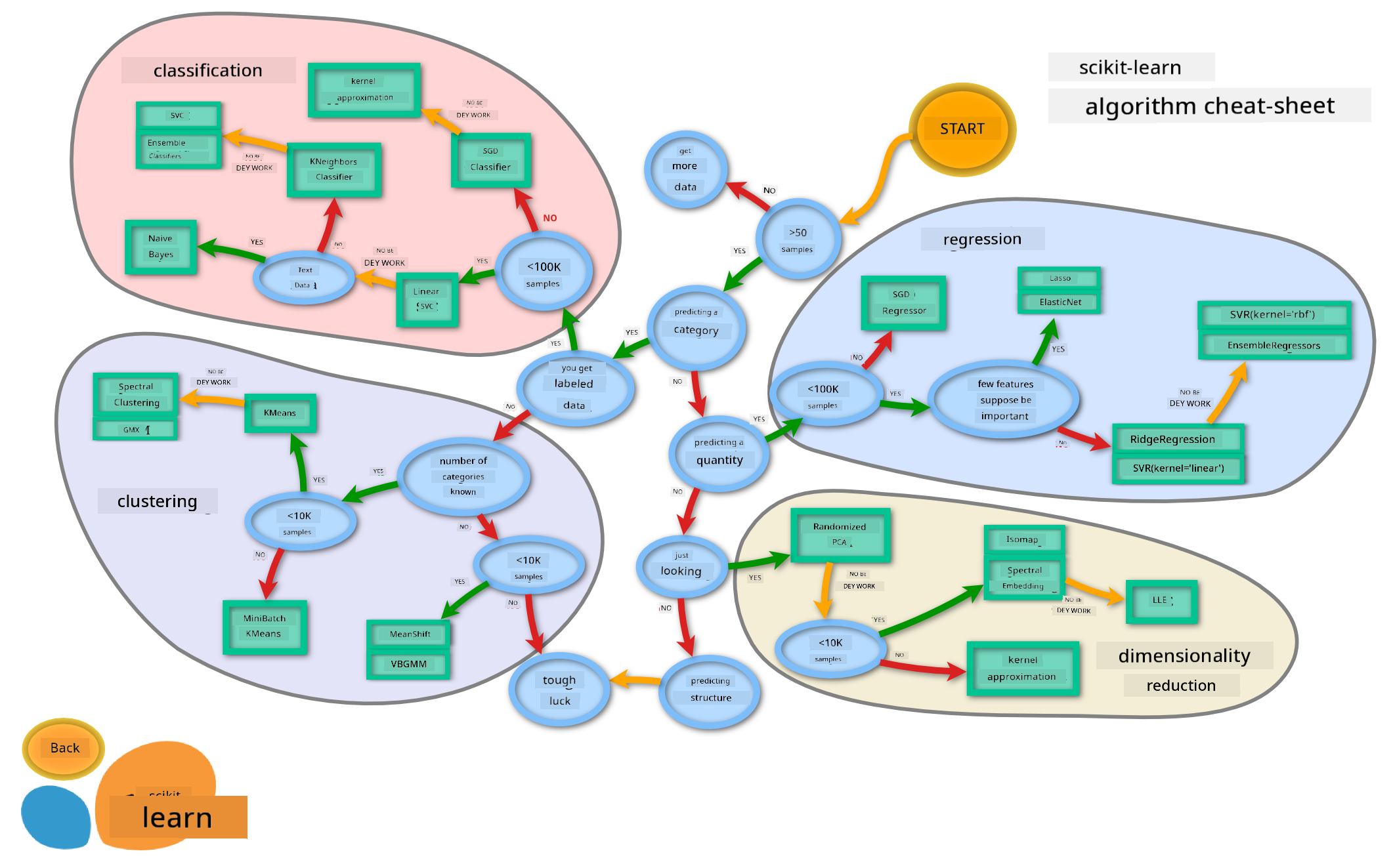
Tip: visit dis map online and click along the path to read documentation.
The plan
Dis map dey very helpful once you sabi your data well, as you fit 'walk' along the paths to make decision:
- We get >50 samples
- We wan predict category
- We get labeled data
- We get less than 100K samples
- ✨ We fit choose Linear SVC
- If e no work, since we get numeric data
- We fit try ✨ KNeighbors Classifier
- If e no work, try ✨ SVC and ✨ Ensemble Classifiers
- We fit try ✨ KNeighbors Classifier
Dis path dey very helpful to follow.
Exercise - split the data
Follow dis path, we suppose start by importing some libraries wey we go use.
-
Import the libraries wey we need:
from sklearn.neighbors import KNeighborsClassifier from sklearn.linear_model import LogisticRegression from sklearn.svm import SVC from sklearn.ensemble import RandomForestClassifier, AdaBoostClassifier from sklearn.model_selection import train_test_split, cross_val_score from sklearn.metrics import accuracy_score,precision_score,confusion_matrix,classification_report, precision_recall_curve import numpy as np -
Split your training and test data:
X_train, X_test, y_train, y_test = train_test_split(cuisines_feature_df, cuisines_label_df, test_size=0.3)
Linear SVC classifier
Support-Vector clustering (SVC) na one method from the Support-Vector machines family of ML techniques (learn more about dem below). For dis method, you fit choose 'kernel' to decide how to cluster the labels. The 'C' parameter dey refer to 'regularization' wey dey control how parameters go influence the model. The kernel fit be one of several; here we set am to 'linear' to make sure say we dey use linear SVC. Probability dey default to 'false'; here we set am to 'true' to gather probability estimates. We set the random state to '0' to shuffle the data to get probabilities.
Exercise - apply a linear SVC
Start by creating array of classifiers. You go dey add to dis array as we dey test.
-
Start with Linear SVC:
C = 10 # Create different classifiers. classifiers = { 'Linear SVC': SVC(kernel='linear', C=C, probability=True,random_state=0) } -
Train your model using Linear SVC and print report:
n_classifiers = len(classifiers)

for index, (name, classifier) in enumerate(classifiers.items()):
    classifier.fit(X_train, np.ravel(y_train))

    y_pred = classifier.predict(X_test)
    accuracy = accuracy_score(y_test, y_pred)
    print("Accuracy (train) for %s: %0.1f%% " % (name, accuracy * 100))
    print(classification_report(y_test,y_pred))
The result dey okay:
Accuracy (train) for Linear SVC: 78.6%
              precision    recall  f1-score   support

     chinese       0.71      0.67      0.69       242
      indian       0.88      0.86      0.87       234
    japanese       0.79      0.74      0.76       254
      korean       0.85      0.81      0.83       242
        thai       0.71      0.86      0.78       227

    accuracy                           0.79      1199
   macro avg       0.79      0.79      0.79      1199
weighted avg       0.79      0.79      0.79      1199
K-Neighbors classifier
K-Neighbors na part of the "neighbors" family of ML methods, wey fit work for supervised and unsupervised learning. For dis method, dem dey create predefined number of points and gather data around dem points so dat generalized labels fit dey predicted for the data.
Exercise - apply the K-Neighbors classifier
The previous classifier dey okay, e work well with the data, but maybe we fit get better accuracy. Try K-Neighbors classifier.
-
Add one line to your classifier array (add comma after the Linear SVC item):
'KNN classifier': KNeighborsClassifier(C),The result no too good:
Accuracy (train) for KNN classifier: 73.8%
              precision    recall  f1-score   support

     chinese       0.64      0.67      0.66       242
      indian       0.86      0.78      0.82       234
    japanese       0.66      0.83      0.74       254
      korean       0.94      0.58      0.72       242
        thai       0.71      0.82      0.76       227

    accuracy                           0.74      1199
   macro avg       0.76      0.74      0.74      1199
weighted avg       0.76      0.74      0.74      1199
✅ Learn about K-Neighbors
Support Vector Classifier
Support-Vector classifiers na part of the Support-Vector Machine family of ML methods wey dem dey use for classification and regression tasks. SVMs "map training examples to points for space" to maximize the distance between two categories. Data wey go come later go dey mapped into dis space so dem fit predict their category.
Exercise - apply a Support Vector Classifier
Make we try get better accuracy with Support Vector Classifier.
-
Add comma after the K-Neighbors item, then add dis line:
'SVC': SVC(),The result dey very good!
Accuracy (train) for SVC: 83.2%
              precision    recall  f1-score   support

     chinese       0.79      0.74      0.76       242
      indian       0.88      0.90      0.89       234
    japanese       0.87      0.81      0.84       254
      korean       0.91      0.82      0.86       242
        thai       0.74      0.90      0.81       227

    accuracy                           0.83      1199
   macro avg       0.84      0.83      0.83      1199
weighted avg       0.84      0.83      0.83      1199
✅ Learn about Support-Vectors
Ensemble Classifiers
Make we follow the path reach the end, even though the previous test dey very good. Make we try some 'Ensemble Classifiers, like Random Forest and AdaBoost:
  'RFST': RandomForestClassifier(n_estimators=100),
  'ADA': AdaBoostClassifier(n_estimators=100)
The result dey very good, especially for Random Forest:
Accuracy (train) for RFST: 84.5%
              precision    recall  f1-score   support

     chinese       0.80      0.77      0.78       242
      indian       0.89      0.92      0.90       234
    japanese       0.86      0.84      0.85       254
      korean       0.88      0.83      0.85       242
        thai       0.80      0.87      0.83       227

    accuracy                           0.84      1199
   macro avg       0.85      0.85      0.84      1199
weighted avg       0.85      0.84      0.84      1199

Accuracy (train) for ADA: 72.4%
              precision    recall  f1-score   support

     chinese       0.64      0.49      0.56       242
      indian       0.91      0.83      0.87       234
    japanese       0.68      0.69      0.69       254
      korean       0.73      0.79      0.76       242
        thai       0.67      0.83      0.74       227

    accuracy                           0.72      1199
   macro avg       0.73      0.73      0.72      1199
weighted avg       0.73      0.72      0.72      1199
✅ Learn about Ensemble Classifiers
Dis method of Machine Learning "combine the predictions of several base estimators" to improve the model quality. For our example, we use Random Trees and AdaBoost.
-
Random Forest, na averaging method, e dey build 'forest' of 'decision trees' wey get randomness to avoid overfitting. The n_estimators parameter dey set to the number of trees.
-
AdaBoost dey fit classifier to dataset and then fit copies of dat classifier to the same dataset. E dey focus on the weights of items wey dem classify wrong and adjust the fit for the next classifier to correct am.
🚀Challenge
Each of dis techniques get plenty parameters wey you fit tweak. Research each one default parameters and think about wetin tweaking dis parameters go mean for the model quality.
Post-lecture quiz
Review & Self Study
Plenty grammar dey for dis lessons, so take small time review dis list of useful terminology!
Assignment
Disclaimer:
Dis dokyument don use AI transleshion service Co-op Translator do di transleshion. Even though we dey try make am accurate, abeg make you sabi say machine transleshion fit get mistake or no dey correct well. Di original dokyument wey dey for im native language na di main source wey you go fit trust. For important informashon, e good make you use professional human transleshion. We no go fit take blame for any misunderstanding or wrong meaning wey fit happen because you use dis transleshion.