# Cuisine classifiers 1
在本課程中,您將使用上一課保存的平衡且乾淨的關於不同料理類型的數據集。
您將使用該數據集搭配各種分類器,_根據一組食材預測指定的國家料理_。在此過程中,您將了解更多算法如何用於分類任務的方法。
## [課前測驗](https://ff-quizzes.netlify.app/en/ml/)
# 準備工作
假設您已完成[課程 1](../1-Introduction/README.md),請確認在這四課的根目錄 `/data` 資料夾中存在一個名為 _cleaned_cuisines.csv_ 的檔案。
## 練習 - 預測一個國家料理
1. 在本課的 _notebook.ipynb_ 中,導入該文件以及 Pandas 函式庫:
```python
import pandas as pd
cuisines_df = pd.read_csv("../data/cleaned_cuisines.csv")
cuisines_df.head()
```
數據看起來如下:
| | Unnamed: 0 | cuisine | almond | angelica | anise | anise_seed | apple | apple_brandy | apricot | armagnac | ... | whiskey | white_bread | white_wine | whole_grain_wheat_flour | wine | wood | yam | yeast | yogurt | zucchini |
| --- | ---------- | ------- | ------ | -------- | ----- | ---------- | ----- | ------------ | ------- | -------- | --- | ------- | ----------- | ---------- | ----------------------- | ---- | ---- | --- | ----- | ------ | -------- |
| 0 | 0 | indian | 0 | 0 | 0 | 0 | 0 | 0 | 0 | 0 | ... | 0 | 0 | 0 | 0 | 0 | 0 | 0 | 0 | 0 | 0 |
| 1 | 1 | indian | 1 | 0 | 0 | 0 | 0 | 0 | 0 | 0 | ... | 0 | 0 | 0 | 0 | 0 | 0 | 0 | 0 | 0 | 0 |
| 2 | 2 | indian | 0 | 0 | 0 | 0 | 0 | 0 | 0 | 0 | ... | 0 | 0 | 0 | 0 | 0 | 0 | 0 | 0 | 0 | 0 |
| 3 | 3 | indian | 0 | 0 | 0 | 0 | 0 | 0 | 0 | 0 | ... | 0 | 0 | 0 | 0 | 0 | 0 | 0 | 0 | 0 | 0 |
| 4 | 4 | indian | 0 | 0 | 0 | 0 | 0 | 0 | 0 | 0 | ... | 0 | 0 | 0 | 0 | 0 | 0 | 0 | 0 | 1 | 0 |
1. 現在,導入更多函式庫:
```python
from sklearn.linear_model import LogisticRegression
from sklearn.model_selection import train_test_split, cross_val_score
from sklearn.metrics import accuracy_score,precision_score,confusion_matrix,classification_report, precision_recall_curve
from sklearn.svm import SVC
import numpy as np
```
1. 將 X 和 y 分別劃分成兩個資料框,用於訓練。`cuisine` 可作為標籤資料框:
```python
cuisines_label_df = cuisines_df['cuisine']
cuisines_label_df.head()
```
看起來將會是這樣:
```output
0 indian
1 indian
2 indian
3 indian
4 indian
Name: cuisine, dtype: object
```
1. 丟棄 `Unnamed: 0` 欄位和 `cuisine` 欄位,呼叫 `drop()`。將剩餘資料作為可訓練特徵:
```python
cuisines_feature_df = cuisines_df.drop(['Unnamed: 0', 'cuisine'], axis=1)
cuisines_feature_df.head()
```
您的特徵看起來像這樣:
| | almond | angelica | anise | anise_seed | apple | apple_brandy | apricot | armagnac | artemisia | artichoke | ... | whiskey | white_bread | white_wine | whole_grain_wheat_flour | wine | wood | yam | yeast | yogurt | zucchini |
| ---: | -----: | -------: | ----: | ---------: | ----: | -----------: | ------: | -------: | --------: | --------: | ---: | ------: | ----------: | ---------: | ----------------------: | ---: | ---: | ---: | ----: | -----: | -------: |
| 0 | 0 | 0 | 0 | 0 | 0 | 0 | 0 | 0 | 0 | 0 | ... | 0 | 0 | 0 | 0 | 0 | 0 | 0 | 0 | 0 | 0 | 0 |
| 1 | 1 | 0 | 0 | 0 | 0 | 0 | 0 | 0 | 0 | 0 | ... | 0 | 0 | 0 | 0 | 0 | 0 | 0 | 0 | 0 | 0 | 0 |
| 2 | 0 | 0 | 0 | 0 | 0 | 0 | 0 | 0 | 0 | 0 | ... | 0 | 0 | 0 | 0 | 0 | 0 | 0 | 0 | 0 | 0 | 0 |
| 3 | 0 | 0 | 0 | 0 | 0 | 0 | 0 | 0 | 0 | 0 | ... | 0 | 0 | 0 | 0 | 0 | 0 | 0 | 0 | 0 | 0 | 0 |
| 4 | 0 | 0 | 0 | 0 | 0 | 0 | 0 | 0 | 0 | 0 | ... | 0 | 0 | 0 | 0 | 0 | 0 | 0 | 0 | 1 | 0 | 0 |
現在,您已準備好訓練模型!
## 選擇你的分類器
既然資料已乾淨且準備好做訓練,您得決定用哪個算法來執行這個任務。
Scikit-learn 將分類歸類於監督學習,您會在該類別下看到多種分類方法。[種類](https://scikit-learn.org/stable/supervised_learning.html)乍看之下令人眼花繚亂。以下方法都包含分類技術:
- 線性模型
- 支援向量機
- 隨機梯度下降
- 最近鄰居
- 高斯過程
- 決策樹
- 集成方法(投票分類器)
- 多類與多輸出算法(多類與多標籤分類,多類多輸出分類)
> 你也可以使用[神經網絡來對數據分類](https://scikit-learn.org/stable/modules/neural_networks_supervised.html#classification),但那超出本課範圍。
### 選擇哪個分類器?
那麼,應該選哪個分類器呢?通常,可以嘗試多個方法,看看哪個結果最好是檢測的好方法。Scikit-learn 提供了一個對比[範例](https://scikit-learn.org/stable/auto_examples/classification/plot_classifier_comparison.html),在一個自己製作的數據集上比較 KNeighbors、SVC 兩種方式、GaussianProcessClassifier、DecisionTreeClassifier、RandomForestClassifier、MLPClassifier、AdaBoostClassifier、GaussianNB 及 QuadraticDiscrinationAnalysis,並以視覺化展示結果:
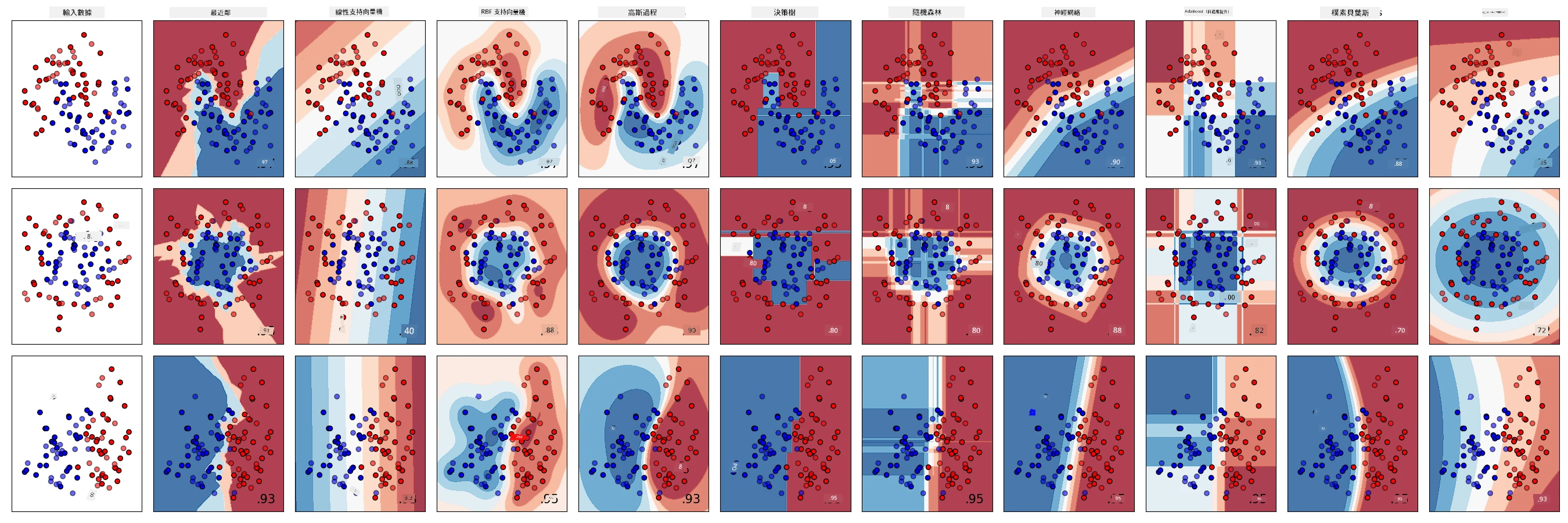
> 由 Scikit-learn 文件生成的圖表
> AutoML 通過在雲端運行這些比較來巧妙解決此問題,讓您可選擇最適合自己數據的算法。試試看[這裡](https://docs.microsoft.com/learn/modules/automate-model-selection-with-azure-automl/?WT.mc_id=academic-77952-leestott)
### 一個更好的方法
比起盲目猜測,跟隨這個可下載的 [ML 速查表](https://docs.microsoft.com/azure/machine-learning/algorithm-cheat-sheet?WT.mc_id=academic-77952-leestott) 的想法會更好。在這裏,我們發現針對我們的多類問題,有以下幾種選擇:

> 微軟算法速查表的其中一部分,詳列多類分類的選項
✅ 下載這張速查表,列印出來,並掛在桌旁!
### 推理分析
讓我們看看能否依照我們的限制條件,推斷出不同方法的合理性:
- 神經網絡太重。基於我們潔淨但有限的資料集,以及我們在筆記本中本地訓練的事實,神經網絡對此任務來說過於龐大。
- 沒有雙類分類器。我們沒有使用雙類分類器,因此排除 one-vs-all 的方法。
- 決策樹或邏輯迴歸可能奏效。決策樹可能有效,或者使用適合多類資料的邏輯迴歸。
- 多類提升決策樹解決不同問題。多類提升決策樹適合非參數任務,例如用來建立排序的任務,因此對我們無用。
### 使用 Scikit-learn
我們將使用 Scikit-learn 來分析資料。但 Scikit-learn 中有許多使用邏輯迴歸的方法。看看[必須傳入的參數](https://scikit-learn.org/stable/modules/generated/sklearn.linear_model.LogisticRegression.html?highlight=logistic%20regressio#sklearn.linear_model.LogisticRegression)。
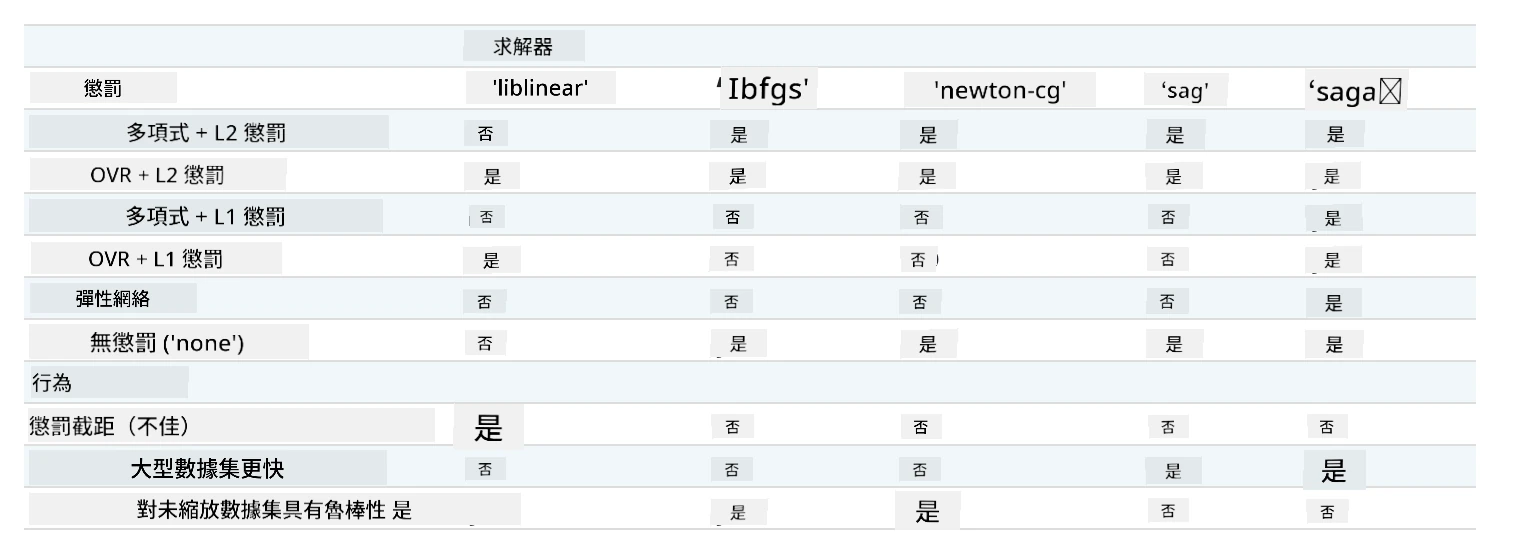
主要有兩個重要參數 - `multi_class` 和 `solver` - 需要指定,當您要求 Scikit-learn 執行邏輯迴歸時。`multi_class` 設定套用特定行為。`solver` 定義使用的算法。並非所有 solver 都能搭配所有 `multi_class` 參數。
根據文件,對多類情況而言,訓練算法:
- **使用 one-vs-rest (OvR) 機制**,當 `multi_class` 選項設定為 `ovr`
- 使用交叉熵損失,當 `multi_class` 選項設定為 `multinomial`。(目前 `multinomial` 僅支援 ‘lbfgs’, ‘sag’, ‘saga’ 和 ‘newton-cg’ solver。)"
> 🎓 此處的 'scheme' 可設為 'ovr'(一對多)或 'multinomial'(多項式)。因邏輯迴歸本質設計為二分類,這些機制幫助其更好地處理多類分類任務。 [來源](https://machinelearningmastery.com/one-vs-rest-and-one-vs-one-for-multi-class-classification/)
> 🎓 'solver' 定義為「優化問題中所用的算法」。[來源](https://scikit-learn.org/stable/modules/generated/sklearn.linear_model.LogisticRegression.html?highlight=logistic%20regressio#sklearn.linear_model.LogisticRegression)
Scikit-learn 以此表格解釋不同 solver 如何處理不同數據結構的挑戰:
## 練習 - 分割數據
我們可聚焦於邏輯迴歸,作為首次訓練嘗試,因為您之前課程中剛學習過它。
呼叫 `train_test_split()` 將資料分割為訓練組和測試組:
```python
X_train, X_test, y_train, y_test = train_test_split(cuisines_feature_df, cuisines_label_df, test_size=0.3)
```
## 練習 - 應用邏輯迴歸
因為您使用多類情況,您需要選擇使用的 _機制_ 與設定的 _solver_。用 multi_class 設為 `ovr` 且 solver 設為 **liblinear** 的 LogisticRegression 做訓練。
1. 建立一個 multi_class 設為 `ovr` 且 solver 是 `liblinear` 的邏輯迴歸:
```python
lr = LogisticRegression(multi_class='ovr',solver='liblinear')
model = lr.fit(X_train, np.ravel(y_train))
accuracy = model.score(X_test, y_test)
print ("Accuracy is {}".format(accuracy))
```
✅ 試試其他 solver,例如經常作為預設的 `lbfgs`
> 注意,如有需要,請使用 Pandas 的 [`ravel`](https://pandas.pydata.org/pandas-docs/stable/reference/api/pandas.Series.ravel.html) 函式來壓平資料。
準確率相當好,超過 **80%**!
1. 透過測試一筆資料(第 50 行)來看看此模型在運作時的表現:
```python
print(f'ingredients: {X_test.iloc[50][X_test.iloc[50]!=0].keys()}')
print(f'cuisine: {y_test.iloc[50]}')
```
列印輸出結果:
```output
ingredients: Index(['cilantro', 'onion', 'pea', 'potato', 'tomato', 'vegetable_oil'], dtype='object')
cuisine: indian
```
✅ 更換不同的行號來檢查結果
1. 挖得更深,你可以檢查這個預測的準確性:
```python
test= X_test.iloc[50].values.reshape(-1, 1).T
proba = model.predict_proba(test)
classes = model.classes_
resultdf = pd.DataFrame(data=proba, columns=classes)
topPrediction = resultdf.T.sort_values(by=[0], ascending = [False])
topPrediction.head()
```
結果列印出來 - 印度料理是其最佳猜測,且機率相當高:
| | 0 |
| -------: | -------: |
| indian | 0.715851 |
| chinese | 0.229475 |
| japanese | 0.029763 |
| korean | 0.017277 |
| thai | 0.007634 |
✅ 你能解釋為什麼模型相當確定這是印度料理嗎?
1. 如同迴歸課程一樣,透過列印分類報告取得更多細節:
```python
y_pred = model.predict(X_test)
print(classification_report(y_test,y_pred))
```
| | precision | recall | f1-score | support |
| ------------ | --------- | ------ | -------- | ------- |
| chinese | 0.73 | 0.71 | 0.72 | 229 |
| indian | 0.91 | 0.93 | 0.92 | 254 |
| japanese | 0.70 | 0.75 | 0.72 | 220 |
| korean | 0.86 | 0.76 | 0.81 | 242 |
| thai | 0.79 | 0.85 | 0.82 | 254 |
| accuracy | | | 0.80 | 1199 |
| macro avg | 0.80 | 0.80 | 0.80 | 1199 |
| weighted avg | 0.80 | 0.80 | 0.80 | 1199 |
## 🚀挑戰
在本課程中,你使用清理過的資料建構了一個機器學習模型,可以根據一系列的食材預測國家料理。花點時間閱讀 Scikit-learn 提供的多種資料分類選項。深入了解「solver」的概念,以理解幕後的運作原理。
## [課後小測驗](https://ff-quizzes.netlify.app/en/ml/)
## 複習與自學
深入探究邏輯斯迴歸背後的數學原理,請參閱[此課程](https://people.eecs.berkeley.edu/~russell/classes/cs194/f11/lectures/CS194%20Fall%202011%20Lecture%2006.pdf)
## 作業
[研究 solver](assignment.md)
---
**免責聲明**:
本文件使用 AI 翻譯服務 [Co-op Translator](https://github.com/Azure/co-op-translator) 進行翻譯。雖然我們致力於準確性,但請注意,自動翻譯可能包含錯誤或不準確之處。原始文件的母語版本應視為權威來源。對於重要資訊,建議採用專業人工翻譯。我們不承擔因使用此翻譯而引起的任何誤解或曲解之責任。