
 Hyejeong443
d9bd916cc9
Hyejeong443
d9bd916cc9
|
4 years ago | |
|---|---|---|
| .. | ||
| translations | 4 years ago | |
| README.md | 4 years ago | |
| assignment.md | 4 years ago | |
| data-communication-emerson-presentation-graphic.xlsx | 4 years ago | |
README.md
데이터 사이언스 생활주기(life cycle) : 소통(communication)
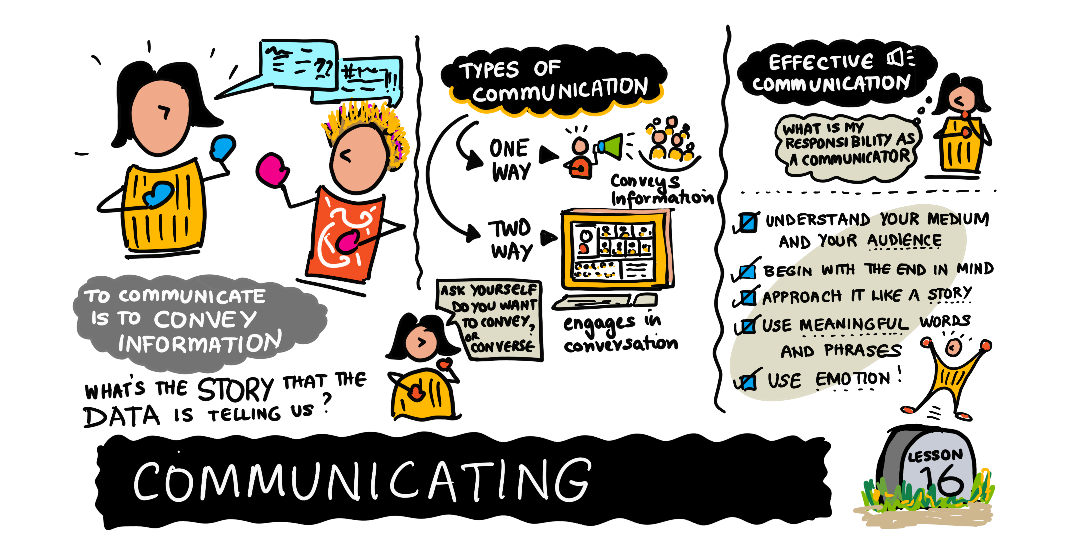 |
|---|
| 데이터 사이언스 생활주기 : 소통 - Sketchnote by @nitya |
강의 전 퀴즈
위의 사전 강의 퀴즈와 함께 제공되는 내용을 테스트해 보십시오!
개요
소통이란 무엇인가?
의사소통의 의미를 정의하는 것으로 이 수업을 시작하겠습니다. 소통하는 것은 정보를 전달하거나 교환하는 것입니다. 정보는 아이디어, 생각, 느낌, 메시지, 은밀한 신호, 데이터 등 sender (정보를 보내는 사람)가 수신기 (정보를 받는 사람)에게 이해하길 원하는 모든 것이 될 수 있습니다. 이 과정에서는 송신자를 전달자로, 수신자를 청중으로 언급할 것입니다.
데이터 통신 & 스토리텔링
우리는 의사소통의 목적이 정보를 전달하거나 교환하는 것이라는 것을 이해한다. 하지만 데이터를 전달할 때, 여러분의 목표는 단순히 청중들에게 숫자를 전달하는 것이 아니어야 합니다. 여러분의 목표는 데이터를 통해 정보를 전달하는 것이어야 합니다 - 효과적인 데이터 커뮤니케이션과 스토리텔링이 함께 진행됩니다. 청중들은 여러분이 들려주는 숫자보다 여러분이 들려주는 이야기를 더 잘 기억할 것입니다. 이 레슨의 후반부에서 스토리텔링을 사용하여 데이터를 보다 효과적으로 전달할 수 있는 몇 가지 방법에 대해 살펴보겠습니다.
통신의 종류
이 레슨 내내 단방향 통신과 양방향 통신이라는 두 가지 유형의 통신에 대해 논의합니다.
일방향 통신은 송신자가 피드백이나 응답 없이 수신자에게 정보를 보낼 때 발생합니다. 우리는 매일 단방향 커뮤니케이션의 예를 볼 수 있습니다 - 크고/많은 이메일, 뉴스가 가장 최신 이야기를 전달할 때, 또는 TV 광고에서 제품이 좋은 이유를 알려줄 때 등. 이러한 각각의 경우, 송신자는 정보의 교환을 추구하지 않습니다. 그들은 단지 정보를 전달하거나 전달하려고 할 뿐이다.
양방향 커뮤니케이션은 모든 관련 당사자가 송신자와 수신자 역할을 할 때 발생합니다. 송신자는 수신자와 통신하는 것으로 시작하고 수신자는 피드백 또는 응답을 제공합니다. 쌍방향 커뮤니케이션은 우리가 소통에 대해 이야기할 때 전통적으로 생각하는 것입니다. 우리는 보통 직접 대화하거나 전화 통화, 소셜 미디어 또는 문자 메시지와 같은 방식으로 사람들의 소통 한다고 생각합니다.
데이터를 전달할 때 단방향 커뮤니케이션(직후에 질문이 들어오지 않는 컨퍼런스에서 발표하거나 대규모 그룹을 대상으로 발표할 때)을 사용하는 경우와 양방향 커뮤니케이션(데이터를 사용하여 소수의 이해 관계자를 설득하거나, 팀 동료에게 새로운 것을 구축하는 데 시간과 노력을 투자해야 한다고 설득할 때)을 사용하는 경우가 있습니다.
효과적인 커뮤니케이션
전달자로서 여러분의 책임
통신을 할 때 수신자가 당신이 원하는 정보를 가져 가는지 확인하는 것이 여러분의 일입니다. 데이터를 주고받을 때 수신자가 번호만 가져가는 것이 아니라 그 데이터를 통해 스토리를 얻을 수 있는 데이터를 수신자가 가져가는 것을 원할 것입니다. 훌륭한 데이터 전달자는 훌륭한 스토리텔러입니다.
데이터를 가지고 어떻게 이야기를 할 수 있을까요? 방법은 무궁무진하지만 아래 6가지에 대해 이 수업에서 설명하겠습니다.
- 당신의 청중, 매체 및 커뮤니케이션 방법을 이해하십시오.
- 끝을 염두에 두고 시작하라
- 실제 이야기처럼 접근하라
- 의미 있는 단어와 구문을 사용하라
- 감정을 사용하라
이러한 각 전략은 아래에 자세히 설명되어 있습니다.
1. 청중, 채널 및 커뮤니케이션 방법을 이해하십시오.
여러분이 가족과 소통하는 방법은 여러분이 친구들과 소통하는 방법과 다를 수 있습니다. 여러분은 아마도 듣고 있는 사람들이 더 이해하기 쉬운 다른 단어와 구절을 사용할 것입니다. 데이터 통신 시에도 동일한 방법을 사용해야 합니다. 누구와 소통하고 있는지 생각해 보세요. 당신이 설명하려는 상황에 대하여 그들이 가지고 있는 그들의 목표와 전후사정에 대해 생각해보세요.
대부분의 청중을 한 범주 내에 그룹화할 수 있습니다. 'Harvard Business Review' 기사에서 "[데이터로 스토리를 전하는 방법]"(http://blogs.hbr.org/2013/04/how-to-tell-a-story-with-data/),) Dell의 총괄 전략가인 Jim Stikeleather는 5가지 범주의 고객을 파악합니다.
- 초보자(Novice): 주제에 대한 첫 노출이지만 지나치게 단순화하는 것을 원치 않습니다.
- 일반인(Generalist): 주제를 알고 있지만 개요 이해 및 주요 주제를 찾습니다.
- 관리자(Managerial): 세부사항 접근과의 복잡성과 상호 관계에 대한 심층적이고 실행 가능한 이해
- 전문가(Expert): 더 많은 탐색과 발견, 매우 상세하고 더 적은 스토리텔링
- 임원(Executive): 가중 확률의 중요성과 결론을 얻을 시간만 있습니다.
이러한 카테고리들은 청중에게 데이터를 보여주는 방법을 알려줄 수 있습니다.
청중의 카테고리에 대해 생각하는 것 외에도, 여러분은 청중을 소통하기 위해 사용하고 있는 채널도 고려해야 합니다. 메모나 이메일을 작성하는 경우, 회의나 컨퍼런스에서 발표하거나 하는 경우와는 약간 다르게 접근해야 합니다.
여러분의 청중을 이해하는 것 외에도, 여러분이 그들과 어떻게 의사소통할 것인지(단방향 또는 양방향) 아는 것 또한 중요하다.
대다수의 초보 청중과 대화하고 일방적인 대화를 사용하는 경우, 먼저 청중을 교육하고 적절한 맥락을 제공해야 합니다. 그런 다음 고객에게 데이터를 제시하고 데이터가 무엇을 의미하는지, 데이터가 중요한 이유를 설명해야 합니다. 이 경우, 청중들은 여러분에게 어떠한 직접적인 질문도 할 수 없기 때문에, 여러분은 명확성을 높이는 것에 초점을 맞추고 싶을지도 모릅니다.
대다수의 관리 대상자와 대화하고 양방향 커뮤니케이션을 사용하는 경우, 청중을 교육하거나 많은 컨텍스트를 제공할 필요가 없습니다. 수집한 데이터와 데이터가 중요한 이유에 대해 바로 논의할 수 있습니다. 그러나 이 시나리오에서는 프레젠테이션 타이밍과 제어에 집중해야 합니다. 양방향 커뮤니케이션을 사용할 때(특히 "세부사항 접근과의 복잡성과 상호 관계에 대한 실행 가능한 이해"를 찾는 관리자와) 대화 중에 토론이 이야기와 관련이 없는 방향으로 진행될 수 있습니다. 이 경우, 조치를 취하여 토론 내용을 다시 본 궤도에 올릴 수 있습니다.
2. 끝을 염두에 두고 시작하라
끝에서부터 시작하는 것은 청중과 대화를 시작하기 전에 여러분이 의도한 바를 이해시키는 것을 의미한다. 청중들이 가져가기를 원하는 것에 대해 미리 생각하는 것은 당신이 청중들이 따라올 수 있는 이야기를 만드는 것에 도움이 됩니다. 단방향 커뮤니케이션과 양방향 커뮤니케이션에 모두 끝부터 시작하는 것이 적절합니다.
끝을 염두에 두고 어떻게 시작할까요? 데이터를 전달하기 전에 중요한 사항을 적어 두십시오. 그리고 나서, 여러분이 데이터를 가지고 하고 싶은 이야기를 준비할 때, 스스로에게 물어보세요. "어떻게 이것이 제가 말하고 있는 이야기와 통합될까?"
주의 – 목표를 염두에 두고 시작하는 것이 이상적이지만, 의도한 결과를 뒷받침하는 데이터만 전달하고 싶지는 않을 것입니다. 이렇게 하는 것을 체리 픽킹이라고 하는데, 이것은 통신자가 그들이 만들고자 하는 지점을 지원하는 데이터만 주고받고 다른 모든 데이터를 무시할 때 발생합니다.
수집한 모든 데이터가 의도한 결과를 명확하게 뒷받침한다면 매우 좋습니다. 그러나 수집한 데이터가 사용자의 핵심 정보를 지원하지 않거나 핵심 정보에 반대하는 주장을 뒷받침하는 경우 해당 데이터도 전달해야 합니다. 이러한 상황이 발생하면, 모든 데이터가 반드시 여러분의 이야기를 뒷받침하는 것은 아니지만 왜 여러분이 이야기를 고수하기로 선택했는지 청중에게 솔직하게 알리십시오.
3. 실제 이야기처럼 접근하라
전통적인 이야기는 5단계로 진행됩니다. 여러분은 Exposition, Rising Action, Clincise, Falling Action 및 Denounation으로 표현된 단계들을 들어본 적이 있을 것입니다. 또는 Context, Conflict, Climax, Closure, Conclusion으로 기억하기 쉽습니다. 데이터와 사례를 전달할 때도 비슷한 방법을 사용할 수 있습니다.
Context에서 시작하여 무대를 설정하고 청중이 모두 같은 페이지에 있는지 확인할 수 있습니다. 그런 다음 Conflict을 소개합니다. 왜 이 데이터를 수집해야 했습니까? 어떤 문제를 해결하려고 했습니까? 그 다음 Climax. 데이터가 무엇입니까? 이 데이터는 무엇을 의미합니까? 데이터에 따르면 우리에게 필요한 솔루션은 무엇입니까? 그런 다음 문제와 제안된 솔루션을 반복할 수 있는 Closure에 도달합니다. 마지막으로, 주요 요점과 팀에게 권장하는 다음 단계를 요약할 수 있는 Conclusion에 도달했습니다.
4. 의미 있는 단어와 구문을 사용하라
만약 여러분과 제가 함께 제품을 작업하다가 "우리 사용자들이 플랫폼에 접속하는 데 시간이 오래 걸린다"고 말했다면, 얼마나 걸릴 것 같습니까? 한 시간? 일주일? 잘 모르겠는데요. 만약 제가 모든 청중에게 그렇게 말한다면요? 모든 청중은 사용자가 당사 플랫폼에 탑승하는 데 걸리는 시간에 대해 각기 다른 생각을 하게 될 수 있습니다.
대신, "전체 사용자가 가입하고 플랫폼에 탑승하는 데 평균 3분이 소요됩니다."라고 말한다면 어떨까요?
이 메시지는 더 명확합니다. 데이터를 전달할 때, 청중 모두가 여러분과 같은 생각을 하고 있다고 생각하기 쉽습니다. 하지만 항상 그런 것은 아니다. 데이터와 데이터의 명확성을 높이는 것은 소통자로서 여러분의 책임 중 하나입니다. 만약 데이터나 여러분의 이야기가 명확하지 않다면, 여러분의 청중은 따라가는데 어려움을 겪을 것이고, 그들이 여러분의 주요 요점을 이해하게 될 가능성이 더 적습니다.
모호한 단어 대신 의미 있는 단어와 구문을 사용하면 데이터를 보다 명확하게 전달할 수 있습니다. 다음은 몇 가지 예입니다.
- 우리는 인상적인 한 해를 보냈어요!
- 한 사람은 2% - 3%의 매출증가를, 한 사람은 50% - 60%의 매출증가를 의미한다고 생각할 수 있습니다.
- 사용자의 성공률이 극적으로 증가했습니다.
- 급격한 상승폭은 얼마나 큰가?
- 이 사업은 중대한 노력이 필요합니다.
- 얼마나 많은 노력이 중요한가?
모호한 단어를 사용하면 앞으로 다가올 더 많은 데이터를 소개하거나 방금 말한 내용을 요약하는 데 유용할 수 있습니다. 하지만 청중들을 위해 프레젠테이션의 모든 부분이 명확하도록 하는 것을 고려하라.
5. Use Emotion
Emotion is key in storytelling. It's even more important when you're telling a story with data. When you're communicating data, everything is focused on the takeaways you want your audience to have. When you evoke an emotion for an audience it helps them empathize, and makes them more likely to take action. Emotion also increases the likelihood that an audience will remember your message.
You may have encountered this before with TV commercials. Some commercials are very somber, and use a sad emotion to connect with their audience and make the data that they're presenting really stand out. Or, some commercials are very upbeat and happy may make you associate their data with a happy feeling.
How do you use emotion when communicating data? Below are a couple of ways.
- Use Testimonials and Personal Stories
- When collecting data, try to collect both quantitative and qualitative data, and integrate both types of data when you're communicating. If your data is primarily quantitative, seek stories from individuals to learn more about their experience with whatever your data is telling you.
- Use Imagery
- Images help an audience see themselves in a situation. When you use images, you can push an audience toward the emotion that you feel they should have about your data.
- Use Color
- Different colors evoke different emotions. Popular colors and the emotions they evoke are below. Be aware, that colors could have different meanings in different cultures.
- Blue usually evokes emotions of peace and trust
- Green is usually related to the nature and the environment
- Red is usually passion and excitement
- Yellow is usually optimism and happiness
- Different colors evoke different emotions. Popular colors and the emotions they evoke are below. Be aware, that colors could have different meanings in different cultures.
Communication Case Study
Emerson is a Product Manager for a mobile app. Emerson has noticed that customers submit 42% more complaints and bug reports on the weekends. Emerson also noticed that customers who submit a complaint that goes unanswered after 48 hours are more 32% more likely to give the app a rating of 1 or 2 in the app store.
After doing research, Emerson has a couple of solutions that will address the issue. Emerson sets up a 30-minute meeting with the 3 company leads to communicate the data and the proposed solutions.
During this meeting, Emerson’s goal is to have the company leads understand that the 2 solutions below can improve the app’s rating, which will likely translate into higher revenue.
Solution 1. Hire customer service reps to work on weekends
Solution 2. Purchase a new customer service ticketing system where customer service reps can easily identify which complaints have been in the queue the longest – so they can tell which to address most immediately.
In the meeting, Emerson spends 5 minutes explaining why having a low rating on the app store is bad, 10 minutes explaining the research process and how the trends were identified, 10 minutes going through some of the recent customer complaints, and the last 5 minutes glossing over the 2 potential solutions.
Was this an effective way for Emerson to communicate during this meeting?
During the meeting, one company lead fixated on the 10 minutes of customer complaints that Emerson went through. After the meeting, these complaints were the only thing that this team lead remembered. Another company lead primarily focused on Emerson describing the research process. The third company lead did remember the solutions proposed by Emerson but wasn’t sure how those solutions could be implemented.
In the situation above, you can see that there was a significant gap between what Emerson wanted the team leads to take away, and what they ended up taking away from the meeting. Below is another approach that Emerson could consider.
How could Emerson improve this approach? Context, Conflict, Climax, Closure, Conclusion Context - Emerson could spend the first 5 minutes introducing the entire situation and making sure that the team leads understand how the problems affect metrics that are critical to the company, like revenue.
It could be laid out this way: "Currently, our app's rating in the app store is a 2.5. Ratings in the app store are critical to App Store Optimization, which impacts how many users see our app in search, and how our app is viewed to perspective users. And ofcourse, the number of users we have is tied directly to revenue."
Conflict Emerson could then move to talk for the next 5 minutes or so on the conflict.
It could go like this: “Users submit 42% more complaints and bug reports on the weekends. Customers who submit a complaint that goes unanswered after 48 hours are more 32% less likely to give our app a rating over a 2 in the app store. Improving our app's rating in the app store to a 4 would improve our visibility by 20-30%, which I project would increase revenue by 10%." Of course, Emerson should be prepared to justify these numbers.
Climax After laying the groundwork, Emerson could then move to the Climax for 5 or so minutes.
Emerson could introduce the proposed solutions, lay out how those solutions will address the issues outlined, how those solutions could be implemented into existing workflows, how much the solutions cost, what the ROI of the solutions would be, and maybe even show some screenshots or wireframes of how the solutions would look if implemented. Emerson could also share testimonials from users who took over 48 hours to have their complaint addressed, and even a testimonial from a current customer service representative within the company who has comments on the current ticketing system.
Closure Now Emerson can spend 5 minutes restating the problems faced by the company, revisit the proposed solutions, and review why those solutions are the right ones.
Conclusion Because this is a meeting with a few stakeholders where two-way communication will be used, Emerson could then plan to leave 10 minutes for questions, to make sure that anything that was confusing to the team leads could be clarified before the meeting is over.
If Emerson took approach #2, it is much more likely that the team leads will take away from the meeting exactly what Emerson intended for them to take away – that the way complaints and bugs are handled could be improved, and there are 2 solutions that could be put in place to make that improvement happen. This approach would be a much more effective approach to communicating the data, and the story, that Emerson wants to communicate.
Conclusion
Summary of main points
- To communicate is to convey or exchange information.
- When communicating data, your aim shouldn't be to simply pass along numbers to your audience. Your aim should be to communicate a story that is informed by your data.
- There are 2 types of communication, One-Way Communication (information is communicated with no intention of a response) and Two-Way Communication (information is communicated back and forth.)
- There are many strategies you can use to telling a story with your data, 5 strategies we went over are:
- Understand Your Audience, Your Medium, & Your Communication Method
- Begin with the End in Mind
- Approach it Like an Actual Story
- Use Meaningful Words & Phrases
- Use Emotion
Post-Lecture Quiz
Recommended Resources for Self Study
The Five C's of Storytelling - Articulate Persuasion
1.4 Your Responsibilities as a Communicator – Business Communication for Success (umn.edu)
How to Tell a Story with Data (hbr.org)
Two-Way Communication: 4 Tips for a More Engaged Workplace (yourthoughtpartner.com)
6 succinct steps to great data storytelling - BarnRaisers, LLC (barnraisersllc.com)
How to Tell a Story With Data | Lucidchart Blog
6 Cs of Effective Storytelling on Social Media | Cooler Insights
The Importance of Emotions In Presentations | Ethos3 - A Presentation Training and Design Agency
Data storytelling: linking emotions and rational decisions (toucantoco.com)
Emotional Advertising: How Brands Use Feelings to Get People to Buy (hubspot.com)
Choosing Colors for Your Presentation Slides | Think Outside The Slide
How To Present Data [10 Expert Tips] | ObservePoint
Microsoft Word - Persuasive Instructions.doc (tpsnva.org)
The Power of Story for Your Data (thinkhdi.com)
Common Mistakes in Data Presentation (perceptualedge.com)
Infographic: Here are 15 Common Data Fallacies to Avoid (visualcapitalist.com)
Cherry Picking: When People Ignore Evidence that They Dislike – Effectiviology
Tell Stories with Data: Communication in Data Science | by Sonali Verghese | Towards Data Science
1. Communicating Data - Communicating Data with Tableau [Book] (oreilly.com)