
 Dmitri Soshnikov
b888941e1d
Dmitri Soshnikov
b888941e1d
|
5 years ago | |
|---|---|---|
| .. | ||
| images | 5 years ago | |
| solution | 5 years ago | |
| translations | 5 years ago | |
| README.md | 5 years ago | |
| assignment.md | 5 years ago | |
| notebook.ipynb | 5 years ago | |
README.md
A Brief Introduction to Statistics and Probability
Statistics and Probability Theory are two highly related areas of Mathematics that are highly relevant to Data Science. It is possible to operate with data without deep knowledge of mathematics, but it is still better to know at least some basic concepts. Here we will present a short introduction that will help you get started.
Pre-Lecture Quiz
Pre-lecture quiz
Probability and Random Variables
Probability is a number between 0 and 1 that expresses how probable an event is. It is defined as a number of positive outcomes (that lead to the event), divided by total number of outcomes, given that all outcomes are equally probable. For example, when we roll a dice, the probability that we get an even number is 3/6 = 0.5.
When we talk about events, we use random variables. For example, the random variable that represents a number obtained when rolling a dice would take values from 1 to 6. Set of numbers from 1 to 6 is called sample space. We can talk about probability of a random variable taking a certain value, for example P(X=3)=1/6.
The random variable in previous example is called discrete, because it has a countable sample space, i.e. there are separate values that can be enumerated. There are cases when sample space is a range of real numbers, or the whole set of real numbers. Such variables are called continuous. An good example is the time when the bus arrives.
Probability Distribution
In the case of discrete random variables, it is easy to describe the probability of each event by a function P(X). For each value s from sample space S it will give a number from 0 to 1, such that the sum of all values of P(X=s) for all events would be 1.
The most well-known discrete distribution is uniform distribution, in which there is a sample space of N elements, with equal probability of 1/N for each of them.
It is more difficult to describe the probability distribution of a continuous variable, with values drawn from some interval [a,b], or the whole set of real numbers ℝ. Consider the case of bus arrival time. In fact, for each exact arrival time t, the probability of a bus arriving at exactly that time is 0!
Now you know that events with 0 probability happen, and very often! At least each time when the bus arrives!
We can only talk about the probability of a variable falling in a given interval of values, eg. P(t1≤X<t2). In this case, probability distribution is described by a probability density function p(x), such that
An continuous analog of uniform distribution is called continuous uniform, which is defined on a finite interval. A probability that the value X falls into an interval of length l is proportional to l, and rises up to 1.
Another important distribution is normal distribution, which we will talk about in more detail below.
Mean, Variance and Standard Deviation
Suppose we draw a sequence of n samples of a random variable X: x1, x2, ..., xn. We can define mean (or arithmetic average) value of the sequence in the traditional way as (x1+x2+xn)/n. As we grow the size of the sample (i.e. take the limit with n→∞), we will obtain the mean (also called expectation) of the distribution.
It can be demonstrated that for any discrete distribution with values {x1, x2, ..., xN} and corresponding probabilities p1, p2, ..., pN, the expectation would equal to E(X)=x1p1+x2p2+...+xNpN.
To identify how far the values are spread, we can compute the variance σ2 = ∑(xi - μ)2/n, where μ is the mean of the sequence. The value σ is called standard deviation, and σ2 is called a variance.
Real-world Data
When we analyze data from real life, they often are not random variables as such, in a sense that we do not perform experiments with unknown result. For example, consider a team of baseball players, and their body data, such as height, weight and age. Those numbers are not exactly random, but we can still apply the same mathematical concepts. For example, a sequence of people's weights can be considered to be a sequence of values drawn from some random variable. Below is the sequence of weights of actual baseball players from Major League Baseball, taken from this dataset (for your convenience, only first 20 values are shown):
[180.0, 215.0, 210.0, 210.0, 188.0, 176.0, 209.0, 200.0, 231.0, 180.0, 188.0, 180.0, 185.0, 160.0, 180.0, 185.0, 197.0, 189.0, 185.0, 219.0]
When working with real-world data, we assume that all data points are samples drawn from some probability distribution. This assumption allows us to apply machine learning techniques and build working predictive models.
To see what is the distribution of our data, we can plot a graph called a histogram. X-axis would contain a number of different weight intervals (so-called bins), and vertical axis would show the number of times our random variable sample was inside a given interval.

From this histogram you can see that all values are centered around certain mean weight, and the further we go from that weight - the fewer weights of that value are encountered. I.e., it is very improbable that a weight of a baseball player would be very different from the mean weight. Variance of weights show the extent to which weights are likely to differ from the mean.
If we take weights of other people, not from the baseball league, the distribution is likely to be different. However, the shape of the distribution will be the same, but mean and variance would change. So, if we train our model on baseball players, it i likely to give wrong results when applied to students of a university, because the underlying distribution is different.
Normal Distribution
The distribution of weights that we have seen above is very typical, and many measurements from real world follow the same type of distribution, but with different mean and variance. This distribution is called normal distribution, and it plays very important role in statistics.
Using normal distribution is a correct way to generate random weights of potential baseball players. Once we know mean weight mean and standard deviation std, we can generate 1000 weight samples in the following way:
samples = np.random.normal(mean,std,1000)
If we plot the histogram of the generated samples we will see the picture very similar to the one shown above. And if we increase the number of samples and the number of bins, we can generate a picture of a normal distribution that is more close to ideal:
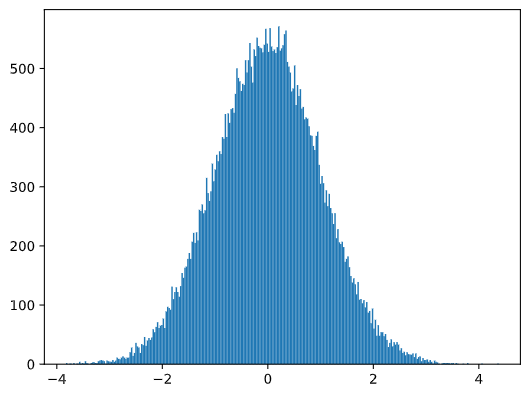 Normal Distribution with mean=0 and std.dev=1
Law of Large Numbers and Central Limit Theorem
One of the reasons why normal distribution is so important is so-called central limit theorem. Suppose we have a large sample of independent N values X1, ..., XN, sampled from any distribution with mean μ and variance σ2. Then, for sufficiently large N (in other words, when N→∞), the mean ΣiXi would be normally distributed, with mean μ and variance σ2/N.
Another way to interpret central limit theorem is to say that regardless of distribution, when you compute the mean of any random variable values you end up with normal distribution.
From central limit theorem it also follows that, when N→∞, the probability of the sample mean to be equal to μ becomes 1. This is known as the law of large numbers.
🚀 Challenge
Post-Lecture Quiz
Post-lecture quiz