
 Amagash
b07119d835
Amagash
b07119d835
|
5 years ago | |
|---|---|---|
| .. | ||
| img | 5 years ago | |
| solution | 5 years ago | |
| translations | 5 years ago | |
| README.md | 5 years ago | |
| assignment.md | 5 years ago | |
| notebook.ipynb | 5 years ago | |
README.md
Data Science in the Cloud: The "Azure ML SDK" way
Table of contents:
Pre-Lecture Quiz
Pre-lecture quiz
1. Introduction
1.1 What is Azure ML SDK?
Data scientists and AI developers use the Azure Machine Learning SDK to build and run machine learning workflows with the Azure Machine Learning service. You can interact with the service in any Python environment, including Jupyter Notebooks, Visual Studio Code, or your favorite Python IDE.
Key areas of the SDK include:
- Explore, prepare and manage the lifecycle of your datasets used in machine learning experiments.
- Manage cloud resources for monitoring, logging, and organizing your machine learning experiments.
- Train models either locally or by using cloud resources, including GPU-accelerated model training.
- Use automated machine learning, which accepts configuration parameters and training data. It automatically iterates through algorithms and hyperparameter settings to find the best model for running predictions.
- Deploy web services to convert your trained models into RESTful services that can be consumed in any application.
Learn more about the Azure Machine Learning SDK
In the previous lesson, we saw how to train, deploy and consume a model in a Low code/No code fashion. We used the Heart Failure dataset to generate and Heart failure prediction model. In this lesson, we are going to do the exact same thing but using the Azure Machine Learning SDK.
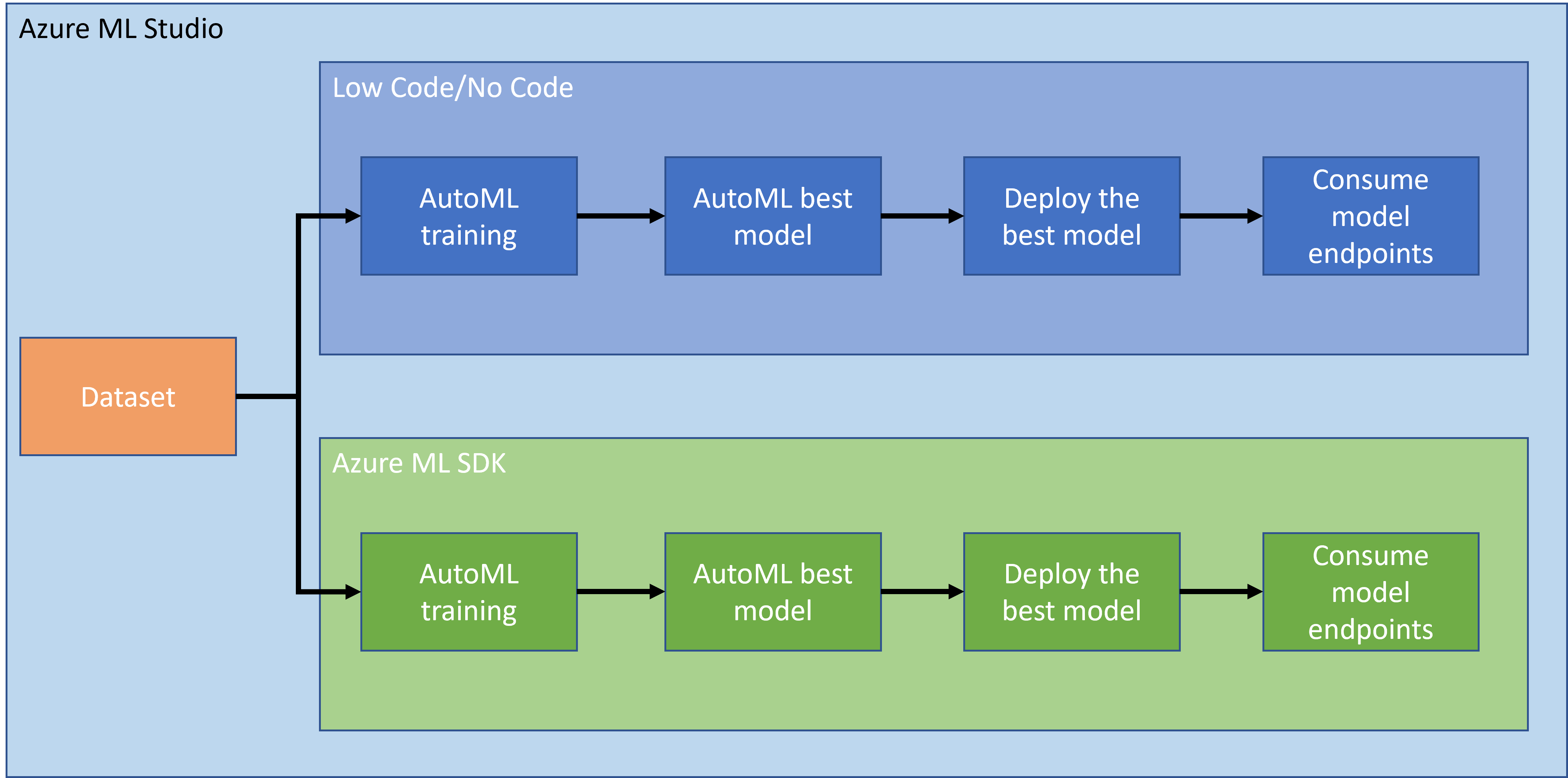
Check here the Heart failure prediction project and dataset introduction.
🚀 Challenge
Post-Lecture Quiz
Post-lecture quiz